


In the field of overhead transmission lines, insulators are core components that ensure insulation performance and mechanical stability. Among the various types of insulators widely used in power systems, polymer insulators (also called composite insulators) and porcelain insulators (traditional ceramic insulators) are the two most common options. While both serve the basic function of isolating conductors from transmission towers and bearing mechanical loads, they differ significantly in material composition, performance characteristics, application scenarios, and even maintenance requirements. Understanding these differences is crucial for power engineering professionals to select the right insulator type, ensure line safety, and optimize operation costs.
To help you intuitively grasp the key distinctions between the two, we have summarized their differences in material, mechanical performance, electrical performance, application, maintenance, and cost in the following table—all based on practical engineering experience and industry standards, ensuring authenticity and comprehensiveness.
Firstly, here are what a polymer insulator and a porcelain insulator look like:
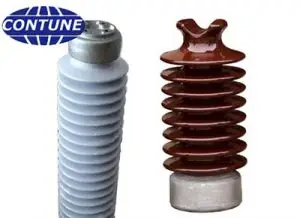
A porcelian insulator is made of porcelain as body and metallic fitting on one side or both sides for fixing on the groud/poles.
Here, these 2 insulator are post type insulators, with white and brown color.
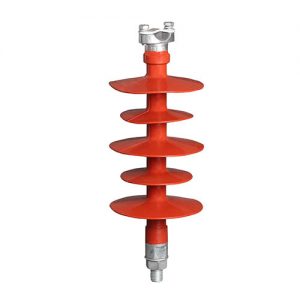
A polymer insulator is made of a fiberglass rod inside as the core (invisible here), with silicon rubber shes (red). On both sides there are metallic fittings for fixing the conductors or other fittings and for installation on the poles.
Here are some difference between polymer Insulators and porcelain Insulators
| Key Aspects | Polymer Insulators | Porcelain Insulators |
| Material Composition | Made of composite materials, usually with a glass fiber reinforced plastic (FRP) core and a silicone rubber shed. The core bears mechanical load, while the shed provides insulation and pollution resistance. | Made of high-purity alumina ceramic (porcelain clay as the main raw material),经过 high-temperature sintering. The entire structure is integrally formed, with good compactness and hardness. |
| Mechanical Performance | Lightweight (1/5 to 1/3 of porcelain insulators), high tensile strength, and good flexibility. Not easy to break under sudden impact or bending, and has strong fatigue resistance against long-term wind vibration. | Heavy weight, high compressive strength, but brittle in nature. Prone to cracking or breaking when subjected to impact, uneven load, or improper transportation and installation. |
| Electrical Insulation Performance | Excellent pollution resistance—silicone rubber shed has hydrophobicity and hydrophobic migration, which can effectively prevent pollution flashover even in heavy industrial pollution or coastal areas. Good insulation stability in humid environments. | Good insulation performance under clean conditions, but poor pollution resistance. The porcelain surface is hydrophilic, and dirt is easy to accumulate, which may cause pollution flashover in humid and polluted environments. Need regular cleaning. |
| Application Scenarios | Widely used in 10KV-500KV overhead transmission lines, especially suitable for harsh environments such as heavy pollution, coastal areas (corrosion resistance), high altitude, and strong wind areas. Also used in renovation projects due to lightweight and easy installation. | Traditional choice for 35KV and above transmission lines, suitable for clean or slightly polluted areas such as rural areas and non-industrial zones. Commonly used in large-span lines due to high compressive strength. |
| Maintenance Requirements | Low maintenance cost. The silicone rubber shed is not easy to accumulate dirt, and generally only requires regular visual inspection to check for shed damage or aging, without frequent cleaning. | High maintenance cost. Need regular cleaning to remove surface dirt and prevent pollution flashover. Also need to check for cracks or chipping, and replace damaged insulators in time to avoid failure. |
| Service Life & Cost | Service life is about 20-30 years. Higher initial cost than ordinary porcelain insulators, but lower overall cost due to low maintenance and long service life. | Service life is about 15-25 years. Lower initial cost, but higher overall cost due to high maintenance frequency and short service life in harsh environments. |
The above differences directly determine the selection of insulators in practical engineering, and also affect the subsequent quality control and testing work. Whether you choose polymer or porcelain insulators, ensuring their performance meets the required standards is the key to safe operation of transmission lines—and this requires professional testing equipment.
We know you may have more questions about the differences between the two insulators, as well as related testing and production equipment. Below are common Q&As to help you deepen your understanding, and we will guide you to explore more professional solutions on our website:
Q&A About Polymer & Porcelain Insulators, Testing & Production Equipment
Q1: For a coastal power transmission line with heavy salt fog, which insulator is more suitable, polymer or porcelain?
A1: Polymer insulators are more suitable. The silicone rubber shed of polymer insulators has excellent hydrophobicity and corrosion resistance, which can effectively resist the erosion of salt fog and avoid pollution flashover. Porcelain insulators, on the other hand, are prone to surface corrosion and dirt accumulation in coastal environments, requiring frequent maintenance and increasing operation costs.
Q2: Do polymer and porcelain insulators require different mechanical testing methods? What equipment is needed?
A2: Their mechanical testing methods share some similarities and also have distinct differences, which are closely related to the type and application of the insulators. Specifically, the same tests are required for the same type of insulators regardless of their material: for example, suspension insulators—whether polymer or porcelain—used to bear the tension of conductors must undergo a mechanical tension test; for post and pin insulators, both polymer and porcelain types need to pass a bending strength test. The differences lie in the unique tests for each material: porcelain insulators require a porosity test to detect the compactness of the ceramic structure (which is crucial for their mechanical and insulation performance), while polymer insulators do not need this test. On the other hand, polymer insulators have their own specific tests that porcelain insulators do not require, such as shed adhesion tests to ensure the silicone rubber shed is firmly bonded to the FRP core. We provide professional insulator testing equipment that can cover both the common and unique mechanical tests of both polymer and porcelain insulators, accurately completing the required tests for insulators below 36KV.
Q3: Besides testing equipment, can you provide equipment for producing polymer or porcelain insulators?
A3: Absolutely. Contune International Co.,Ltd offers a full set of customized solutions, including both insulator testing equipment and production equipment. For polymer insulators, we provide FRP rod grinding machine, crimping machine, marking machine and etc. For porcelain insulators, we currently don’t invole, while most of our machines for porcelain insulators are testing machines, which is also an important part of manufacturing.
>>See more of production machine of polymer insulators
>>See more of testing machines of polymer insulators and porcelain insulators
Q4: How can I learn more about the selection, testing, and production of these two insulators?
A4: We recommend adding Contune International Co.,Ltd to your favorites. Our website has a wealth of professional content on high-voltage electricity, including detailed guides on insulator selection, testing methods, production processes, and product introductions. We update our content regularly to bring you the most practical industry knowledge and equipment information.
If you have more questions about the differences between polymer and porcelain insulators, or if you want to know more about our insulator testing equipment and production equipment, feel free to browse our website or contact our technical team directly—we are always here to provide you with professional support and customized solutions.