


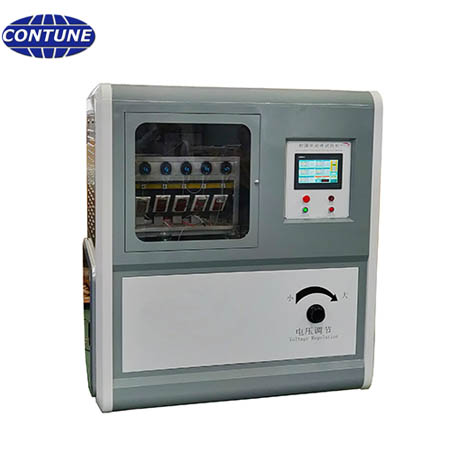
Thermal-mechanical testing is a long-duration reliability test for string insulators, not a quick pull test. The sample is exposed to repeated temperature cycles while a defined tensile load is maintained.
A buyer should evaluate chamber size, number of stations, tensile load, control software and data display before choosing a vertical or horizontal machine.
Source facts used
- Thermal-mechanical testing machine is designed to test thermal-mechanical performance of string insulators.
- Brochure references GB/T19519-2004, IEC/TR 60575:1997 and GB/T22708-2008.
- Insulator units are subjected to four 24-hour cycles of heating/cooling.
- Tensile load equals 60% of the specified electromechanical or mechanical failing load as per IEC 383.
- 2025 vertical models list 1-4 workstations and 500kN tensile load.
- Horizontal single-station model C-TMT-1P/600H lists 600kN max tensile load, 300mm cylinder stroke and 3000×1000×800mm inner chamber.
Why four 24-hour cycles matter
The four-cycle structure is intended to expose the insulator to repeated thermal stress rather than one short temperature change.
Because the test is long, stable control and clear data logging are more important than simple peak-load capacity.
Load level must match the insulator rating
The brochure states a tensile load equal to 60% of the specified electromechanical or mechanical failing load.
That means buyers must know the product rating before sizing the hydraulic and fixture system.
Station count affects throughput
A one-station system may be enough for development or low-volume verification, while multi-station systems improve throughput.
The 2025 vertical series lists 1-4 workstations, which lets buyers choose between budget and sample capacity.
Buyer checklist
- Applicable standard
- Cycle profile
- Tensile load requirement
- Chamber size
- Number of stations
- Software trend display
FAQ
Is this the same as a normal tensile test?
No. The key is simultaneous thermal cycling and sustained mechanical load over long duration.
Why choose multiple stations?
Multiple stations allow more samples to be tested in the same long test window.
Need a practical recommendation? Send product drawings, voltage class, test standard, sample size and destination country through the Contune contact page.