


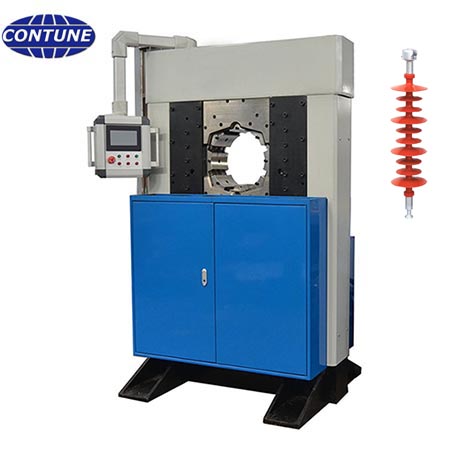
Crimping quality is one of the most sensitive steps in composite insulator production because the end fitting must transfer mechanical load without damaging the FRP rod or creating hidden defects.
The CTCPM-140AS upgrade adds acoustic emission monitoring to the crimping process so the operator can watch pressure, displacement and acoustic response during every cycle.
Source facts used
- CTCPM-140AS includes integrated acoustic emission system as a standard feature since the 2024 upgrade.
- The system provides real-time micro-crack detection during every crimp.
- Live display includes pressure in MPa, acoustic intensity in dB and displacement in mm during each crimp cycle.
- The brochure positions CTCPM-140AS as future-ready for stricter composite insulator QC standards.
Why acoustic emission matters
Traditional crimping checks focus on force, dimension and final inspection. Acoustic emission adds a real-time signal related to micro-crack behavior during deformation.
This does not remove the need for process validation, but it gives factories another layer of quality evidence.
What the operator sees
The brochure lists live pressure in MPa, acoustic intensity in dB and displacement in mm.
Those three signals help separate a normal crimping curve from a cycle that may require review.
Where this fits in a production line
Acoustic emission monitoring is most useful when the factory wants tighter traceability for end fitting assembly.
It should be connected with product drawings, crimping force windows, routine tensile checks and operator training.
Buyer checklist
- End fitting type
- Crimping force window
- Pressure monitoring
- Displacement monitoring
- Acoustic emission threshold
- Traceability record
FAQ
Does acoustic emission replace tensile testing?
No. It supports crimping process monitoring; tensile or mechanical verification may still be required.
Who needs this upgrade?
Factories with stricter quality traceability, export customers or high mechanical reliability requirements should consider it.
Need a practical recommendation? Send product drawings, voltage class, test standard, sample size and destination country through the Contune contact page.