


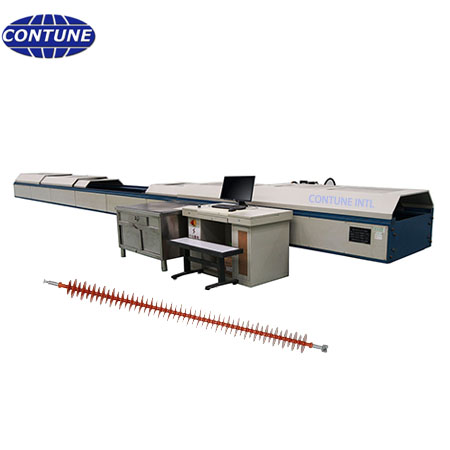
A long rod insulator tensile test can produce a precise force curve and still be a poor test if the sample is misaligned, the end fittings are not seated correctly or the specimen is allowed to carry its own weight unevenly. Fixture preparation and sample handling should therefore be part of the machine specification, commissioning plan and test report.
Contune brochure data for the 10m/1000kN horizontal electronic tensile machine provides concrete reference points: a 1000kN load range and load sensor, 1% FS stated accuracy, 600mm piston stroke, adjustable loading speed from 0 to 200mm/min, programmable pressure-holding time, computer-controlled force/displacement tracking, and a 300mm rail section with a movable self-locking tail stock. These figures describe one configuration and must be checked against the buyer’s actual specimen drawings and test method.
Define the specimen envelope before choosing fixtures
Send minimum and maximum insulator length, shed diameter, end-fitting drawings, coupling type, specified mechanical load and required test orientation. The fixture interface must seat the metal fittings without loading the polymer housing, sheds or FRP rod eccentrically. If several product families share one machine, list every adapter and its rated capacity.
Align the force path through both end fittings
The centerline of the loading cylinder, specimen and tail-stock fixture should form one force path. Check lateral offset, angular error and free rotation before applying significant load. Record fixture position and adapter identification so a repeated test uses the same geometry. Misalignment can add bending stress and make a joint appear weaker than it is.
Support long samples without constraining extension
A long specimen may need rollers or air-supported points during loading. Supports should reduce handling weight and sag but must not lock the specimen as it extends. The brochure describes an air-supporting structure and a movable self-locking tail stock; the final number, height and spacing of supports should be set from sample length, mass and shed profile.
Use stroke and speed as acceptance parameters
The 600mm piston stroke and 0–200mm/min loading-speed range are useful only when the required method fits within them. The RFQ should state preload, loading rate, hold point, hold duration, termination condition and expected displacement. During acceptance, compare commanded speed with measured loading behavior and confirm peak-value protection.
Record force, displacement and events together
The report should identify the sample, fixtures, load cell, calibration date, preload, target rate, force-time curve, displacement-time curve, peak force, hold period and termination reason. Any tail-stock movement, support adjustment, alarm or restart should remain in the event log. A single peak value is not enough for troubleshooting or customer witness review.
Safety and commissioning checks
Verify the protective cover, exclusion zone, emergency stop, over-load protection, fixture ratings and safe sample-loading procedure. Commissioning should include a representative long sample, fixture-change demonstration, operator training and raw-data export. Do not stand in line with a loaded specimen or coupling.
Buyer checklist
- Minimum and maximum sample length and mass
- End-fitting drawings and adapter list
- Maximum load, preload, loading rate and hold time
- Required stroke and expected displacement
- Sample supports and tail-stock adjustment
- Force/displacement accuracy and calibration
- Guarding, exclusion zone and emergency procedure
- Raw data, curves and signed report format
FAQ
Can one fixture cover ball, socket, clevis and eye fittings?
Usually not without dedicated adapters. Each adapter must match the geometry and carry the maximum test load safely.
Why is sample support important on a horizontal machine?
It reduces sag and handling risk, but it must allow axial movement so the support does not distort the tensile result.
Is 1000kN capacity sufficient by itself?
No. Usable length, fixture rating, stroke, speed control, guarding and report requirements must also match the test.
Related resources: horizontal tensile tester, testing machines, project inquiry.