


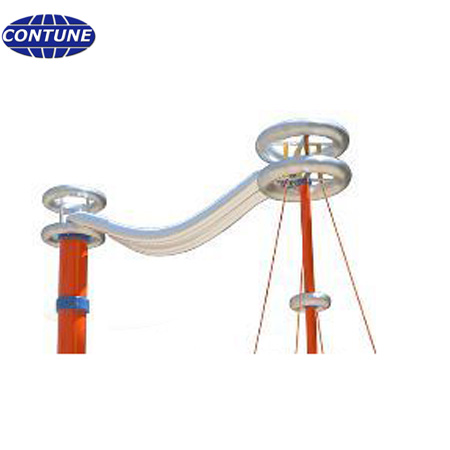
A 500 kV nameplate does not by itself define a complete high-voltage laboratory. The test object, required voltage duration, capacitance, wet-test duty, clearances, earthing, measurement uncertainty and site utilities determine whether the system can perform the intended work safely and repeatably. This guide uses Contune’s 500 kV / 500 kVA brochure; final values must be confirmed for each contract.
Reference configuration
| Component | Brochure specification |
|---|---|
| Rated output | 500 kV AC, 500 kVA |
| Transformer cascade | Lower 500 kVA / 250 kV plus upper 250 kVA / 250 kV |
| Regulator | 125 kVA, 380 V input, 0–650 V output |
| Protective resistor | 500 kV, 5 kΩ |
| Capacitive divider | 500 kV, 400 pF, 2000:1, accuracy ≤1% |
| Compensation reactor | 500 kVA, 600 V |
| Control | PLC, fibre-optic communication, 16-bit acquisition |
Match the source to the test object
Provide the maximum test voltage, duration, test-object capacitance and wet or dry duty. The compensation reactor reduces reactive demand, but its usable operating range must be checked against the actual object. Flashover and puncture work can impose different protective and measurement requirements.
Laboratory and safety inputs
The brochure reference conditions include indoor operation, altitude up to 1,000 m, -10 to +40 °C and independent earthing below 0.5 Ω. These are design inputs, not universal site acceptance. Submit room dimensions, minimum clearances, doors, crane capacity, floor loading, drainage for wet tests and the proposed earth grid. Higher altitude requires insulation coordination review.
Measurement chain
IEC 60060-1 and IEC 60060-2 are cited for high-voltage test and measuring practice. FAT should verify divider ratio, indication, polarity and data acquisition as one measurement chain, not only inspect individual calibration certificates. Record the traceable reference instrument and agreed uncertainty.
FAT checklist
- Nameplates and cascade connections match approved drawings
- Voltage regulator raises and lowers smoothly from zero
- Interlocks, emergency stop, overvoltage and overcurrent protection operate
- Divider readings agree with the reference system at agreed points
- Protective resistor and reactor connections are verified
- PLC sequences, alarms, fibre communication and reports are demonstrated
- Partial-discharge background is checked only when contractually required
- Discharge, earthing and safe-access sequence is witnessed
RFQ data
Send the test standards and editions, product list, highest test voltage, capacitance range, wet-test arrangement, supply frequency, site altitude, earth-grid data, room layout and required automation. State whether installation, commissioning, calibration and operator training are included.
FAQ
Does 500 kV output mean every 500 kV-class product can be tested?
No. Required test voltage, clearance, source kVA, object capacitance and procedure must all fit the system.
Is a compensation reactor optional?
It depends on the reactive burden and available supply. Its need and tuning range should be calculated from the intended objects.