


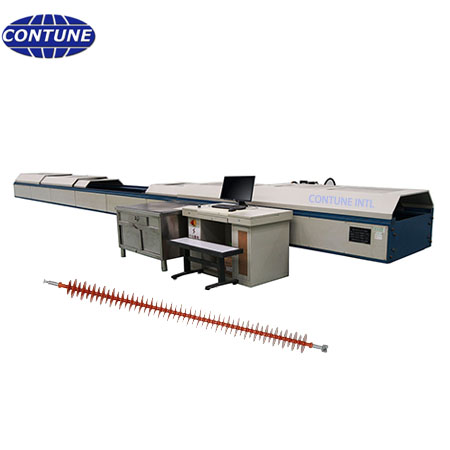
A thermal-mechanical test machine for string insulators is normally purchased as a long-term laboratory asset. The commissioning stage determines whether the machine can hold load, control temperature cycles, fit the buyer’s insulator hardware and produce usable records for acceptance testing.
This checklist is based on Contune thermal-mechanical tester brochure data for vertical and horizontal machines. It is written for buyers who need to prepare site conditions, fixtures, acceptance criteria and operator checks before shipment or installation.
Source facts used
- Applicable references include GB/T19519-2004, IEC/TR 60575:1997 and GB/T22708-2008.
- The thermal-mechanical procedure subjects insulator units to four 24-hour heating/cooling cycles.
- The tensile load is specified as 60% of the electromechanical or mechanical failing load according to the cited IEC 383 reference.
- Vertical 2025 models C-TMT-1P/500V to C-TMT-4P/500V cover 1 to 4 workstations with 500kN tensile load.
- A horizontal C-TMT-1P/600H example lists one workstation, 3000 x 1000 x 800mm inner chamber, 5500 x 2000 x 1600mm outer size, 600kN maximum tensile load and 300mm cylinder stroke.
- The brochure describes live time-strength graphic display and programmable processes for different standards and users.
1. Confirm the standard and load case before delivery
The commissioning plan should start from the standard, the specified mechanical failing load and the exact load percentage required during the cycle. If the project uses GB/T19519, IEC/TR 60575, GB/T22708 or customer-specific acceptance rules, those rules should be visible in the test procedure, software settings and report template.
For many string insulator applications, the brochure describes tensile load equal to 60% of the specified electromechanical or mechanical failing load. That figure must be checked against the buyer’s product drawings and rated failing load before fixture design is accepted.
2. Check chamber size, workstation count and handling route
A vertical multi-station system and a horizontal single-station system solve different handling problems. Vertical models can support 1 to 4 workstations with 500kN tensile load, while the horizontal C-TMT-1P/600H example provides a long chamber for larger strings and lists 600kN maximum tensile load.
Before installation, verify door opening, crane or trolley access, floor space, cable route, service clearance and the path from unpacking area to final position. Chamber inner dimensions should be compared with the longest expected insulator string and its adapter length, not only with the ceramic or composite body length.
3. Validate fixtures and ball/socket adapters
Commissioning should include a dry fit with representative end fittings. Ball and socket connections need correct adapter geometry so the load path stays aligned during heating and cooling. If the fixture introduces side load, the test may stress the connection in a way that does not represent the real product.
Buyers should prepare drawings of end fittings, sample length, fitting material, failing load and expected sample quantity per batch. If multiple voltage classes are tested, adapter sets should be labelled and stored with the machine documentation.
4. Test load, temperature and software records together
The machine should be checked as a complete system. Load holding, cylinder stroke, chamber temperature, timer, cycle program and live time-strength graph should be reviewed during acceptance. It is not enough to confirm that the hydraulic or mechanical section moves.
The report should capture sample ID, workstation, load setpoint, actual load trend, temperature cycle, alarms and operator notes. For production laboratories, this record becomes part of supplier qualification and customer audit evidence.
5. Site preparation before installation
The horizontal sample system lists 3P AC 380V power input and power consumption data, while some installations may require local voltage customization. Confirm power, grounding, room ventilation, ambient temperature, drainage if needed and safe access around moving parts.
For broader project planning, review Contune resources on insulator testing machines and insulator testing laboratory setup.
Buyer checklist
- Applicable standard and exact thermal-mechanical test cycle
- Specified mechanical or electromechanical failing load for each sample family
- Required workstation count and sample length range
- Ball/socket or other end fitting drawings
- Chamber dimensions, door access and handling route
- Power supply, grounding and service clearance
- Report fields, alarm records and calibration documents
FAQ
Should commissioning be done with real insulator samples?
Yes. A no-load machine check cannot prove fixture alignment, sample clearance or load holding during a realistic thermal cycle. Representative samples make commissioning more reliable.
Is a horizontal machine always better for long strings?
Not always. Horizontal machines are useful for long or heavy strings, but the final choice depends on sample length, workshop height, crane access, workstation count and test throughput.
What documents should be kept after commissioning?
Keep the installation checklist, calibration records, fixture drawings, software procedure, test report template, alarm setting sheet and operator training record.
Need a commissioning plan? Send sample drawings, voltage class, failing load, required standard and workshop layout through the Contune contact page.