


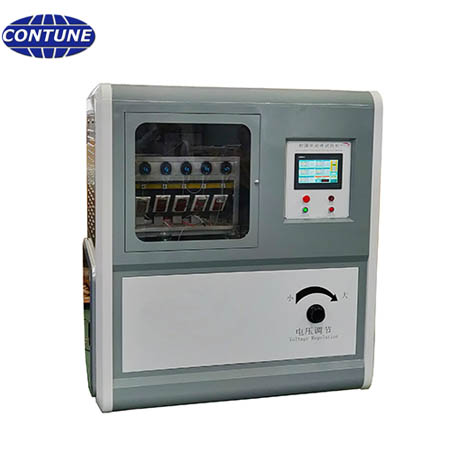
An IEC 60587 tracking and erosion test machine is often purchased for material qualification before composite insulator production or supplier approval. The useful specification is not just the maximum voltage; it includes pollutant delivery, current protection, chamber space and operator safety.
Contune brochure data for the tracking and erosion tester gives practical values buyers can use when preparing an RFQ or checking a supplier proposal.
Source facts used
- The tester is designed for silicone rubber and composite insulator material tracking and erosion evaluation.
- IEC60587-2007 and GB/T6553-2003 are listed as applicable references.
- Example test condition: 2.5kV polluted liquid flow, no overcurrent above 60mA in 6 hours.
- Working space is listed as 800 x 570 x 800mm.
- Overall equipment size is listed as 1620 x 1000 x 1850mm.
- Transformer capacity is listed as 5kVA with 48-62Hz power-frequency range.
- Door interlock cuts high voltage for operator safety.
Start with the material and standard
The sample material, electrode arrangement, solution flow and test duration should be defined before a supplier quotes the machine. IEC 60587 testing is sensitive to setup details, so vague requirements often lead to equipment that is difficult to validate.
For composite insulator manufacturers, this test is normally part of material qualification and supplier control. It should be connected with broader insulator testing laboratory setup planning rather than treated as an isolated bench instrument.
Voltage and current protection are acceptance items
The brochure example cites 2.5kV polluted liquid flow and a 60mA overcurrent reference over 6 hours. Buyers should confirm the required method, voltage steps, trip logic and alarm recording before acceptance.
A useful factory acceptance test should prove that the high voltage output, liquid delivery, current detection and interlock behavior work together. The safest machine is the one whose abnormal conditions are predictable and documented.
Chamber size affects real sample handling
The listed 800 x 570 x 800mm working space should be compared with the buyer’s sample fixture, drainage path and cleaning method. A chamber that is barely large enough on paper may be awkward during routine use.
For routine laboratory operation, also check corrosion-resistant surfaces, visibility, exhaust or ventilation needs, liquid collection and cleaning access.
Reports should support material decisions
The report should not only say pass or fail. It should identify sample batch, voltage, liquid flow, current behavior, duration, visible erosion condition and operator notes.
Internal links should guide readers to related insulator testing machines and the specific tracking and erosion test machine product page where available.
Buyer checklist
- Applicable standard version
- Sample material and size
- Voltage steps and duration
- Polluted liquid formula and flow setting
- Current trip threshold and alarm record
- Working chamber size and cleaning access
- Door interlock and high voltage safety behavior
FAQ
Is IEC 60587 only for finished insulators?
No. It is commonly used for polymeric insulating material evaluation, so manufacturers may use it before finished composite insulator assembly.
Why is liquid flow important?
Tracking and erosion behavior depends on contamination delivery. Unstable flow can make results inconsistent even if the voltage source is stable.
Need a practical equipment recommendation? Send sample type, test standard, capacity target and destination country through the Contune contact page.