


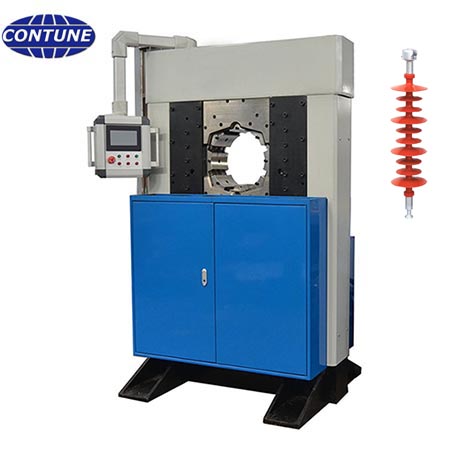
Composite insulator crimping quality depends on more than the hydraulic press. The fixture, end fitting preparation, FRP rod position and data recorded during the cycle decide whether the joint can be traced and repeated.
Contune CTCPM series brochure material highlights acoustic emission monitoring, pressure, displacement and live process display as practical quality-control points for composite insulator end fittings.
Source facts used
- CTCPM-140AS includes an integrated Acoustic Emission System as a standard feature since 2024.
- The acoustic emission system is used for real-time micro-crack detection during each crimp.
- Live display data can include pressure in MPa, acoustic intensity in dB and displacement in mm.
- The machine is positioned for composite insulator end fitting crimping and production-line quality control.
- Recorded crimping data supports traceability, troubleshooting and batch review.
The fixture must represent the real end fitting
Before ordering a crimping machine, the buyer should send end fitting drawings, FRP rod diameter, material specification and target production range. The fixture should locate the fitting consistently and prevent angular or axial error before pressure is applied.
If one factory produces multiple voltage classes, adapter sets should be planned as part of the equipment scope. A machine body may be shared, but the fixture interface often decides whether changeover is fast or risky.
Pressure data needs context
Pressure in MPa is useful, but pressure alone does not prove a good crimp. The displacement curve, final position and cycle behavior show whether the fitting moved as expected and whether tooling wear or material variation affected the joint.
For process qualification, the buyer should define acceptable ranges and connect machine data with pull-out testing or routine mechanical checks.
Acoustic emission adds another quality channel
Acoustic emission monitoring can reveal abnormal signals during the crimp cycle. It does not replace validation tests, but it gives operators another way to detect suspicious cycles before a product leaves the line.
This is especially useful when manufacturers need stronger traceability for export customers, utility audits or internal quality review.
What the RFQ should include
A practical RFQ should include drawings, rod diameter range, fitting material, required capacity, target output, data recording needs and acceptance method. Connect the request with the composite insulator crimping machine page and broader production planning.
If commissioning support is needed, include operator training, tooling list, report format and spare fixture requirements in the same scope.
Buyer checklist
- End fitting drawing and FRP rod diameter
- Voltage class and product family range
- Fixture locating method and adapter sets
- Pressure range and displacement record
- Acoustic emission alarm logic
- Batch traceability and report export
- Pull-out or routine test connection
FAQ
Is acoustic emission monitoring enough to approve every crimp?
No. It is a process-monitoring layer. It should be used with fixture control, process limits, pull-out validation and routine inspection.
Why should fixture planning happen before the machine order?
Late fixture changes can affect stroke, tooling, safety clearance, delivery time and operator workflow.
Need help matching the equipment scope? Send drawings, voltage class, standard, capacity and destination country through the Contune contact page.