


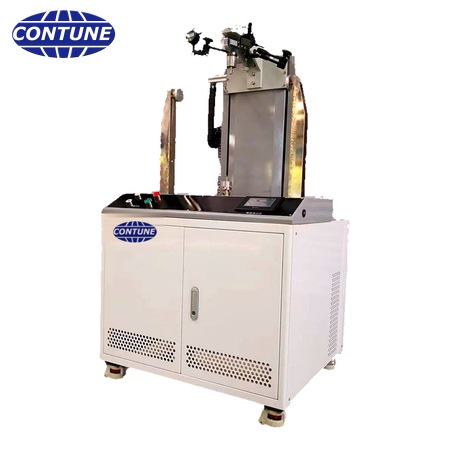
Before ordering a CT-AD26 for ceramic or glass disc insulators, confirm the largest shed diameter, structural height, coupling gauges and the exact supply list. In particular, the Contune brochure lists pin designation 36 as applicable but lists supplied ball-and-socket gauges only for sizes 16, 20, 24, 28 and 32. If size 36 is in your inspection programme, require its gauge to be priced and listed explicitly.
The CT-AD26 product page and the 2026 product brochure describe four checks on one fixture: shed diameter, structural height, axial deviation and radial deviation. This is a single-unit dimensional inspection device, not a tensile-load test machine. The brochure cites IEC 60383-1 and GB/T 1001.1-2003 without identifying an IEC edition. The current IEC 60383-1:2023 scope covers ceramic or glass units for AC overhead power lines above 1,000 V; agree the edition and acceptance limits in the purchase specification rather than assuming them from the instrument.
Match the specimen envelope to the fixture
The brochure gives a maximum shed diameter of 500 mm and an effective structural-height measuring range of at least 400 mm. It lists units rated 70, 160, 210, 300, 420 and 550 kN and pin designations 16, 20, 24, 28, 32 and 36. These are separate lists; do not assume any particular strength rating automatically corresponds to a pin designation. Send a drawing for each unit type, including cap, pin, shed diameter and overall height, and ask the supplier to confirm physical access and positioning.
Compare stated capability with the delivery kit
| Item | Brochure statement | Buyer action |
|---|---|---|
| Axial/radial indication | 0–25.4 mm range; 0.01 mm stated accuracy | Request calibration evidence, zeroing procedure and an agreed check piece |
| Structural height | Effective range at least 400 mm | Check your shortest and tallest units on the fixture drawing |
| Shed diameter | Up to 500 mm | Confirm clearance around the actual cap and shed profile |
| Applicable designations | 16, 20, 24, 28, 32, 36 | List every coupling size in the RFQ |
| Listed gauge supply | 16, 20, 24, 28 and 32; no size 36 gauge shown | Add size 36 gauge explicitly if required and confirm certificate/scope |
The brochure describes two 0–25.4 mm digital dial indicators and two magnetic holders, plus a frame, hand wheel and documents. It says the measuring device needs no external mains supply and automatically works out maximum and minimum deviation. Treat those as offered features to demonstrate at acceptance. The stated 0.01 mm figure is a brochure claim, not a substitute for a traceable calibration and a repeatability check on your own specimen.
Witness a practical acceptance demonstration
- Set up a representative small and large disc unit, identify the datum and repeat the positioning.
- Zero the indicators, measure diameter and height, then record maximum and minimum axial and radial readings.
- Remove and remount the same unit to check repeatability; agree tolerances before the trial.
- Demonstrate every ordered ball-and-socket gauge, especially size 36 if included.
- Record instrument IDs, calibration status, specimen drawing, raw readings and the contractual pass/fail rule.
Do not substitute this check for a post-insulator inspection. Post units need different references and geometry. Ask for a separate fixture review if both product families must be inspected.
FAQ
Does the listed standard kit include a size 36 gauge?
Not in the 2026 brochure’s supply list. Size 36 appears in the applicable-designation list, so request written confirmation and a line item before ordering.
Does 0.01 mm stated accuracy prove the installed system is accurate to 0.01 mm?
No. Ask for a calibration record and demonstrate repeatability on the intended fixture and sample.
Can one fixture check both disc and post insulators?
The CT-AD26 brochure specifies single ceramic or glass disc units. Post-insulator geometry needs a separate inspection approach.