


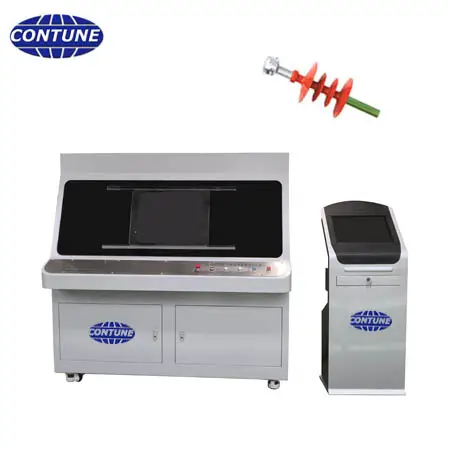
The oil puncture test evaluates the electrical breakdown behavior of a small FRP or ECR core-rod specimen used in a composite insulator. It is a material-sample test, not a puncture test on a complete insulator between its end fittings.
This guide uses Contune product data for model C-FPT-20 and the product page reference to IEC 61109:2008 and GB/T 19519-2014. The governing standard edition, specimen geometry, electrode arrangement, voltage waveform and acceptance rule must be confirmed in the purchaser specification.
Keep the test identity clear
Two tests are often confused in an RFQ. The core-rod test uses a cut FRP/ECR specimen immersed in insulating oil. A complete-insulator puncture test applies voltage to an assembled insulator. They require different specimen handling, clearances and test circuits. State which test is required before selecting equipment.
Control the specimen before energizing
- Record rod manufacturer, batch, diameter and the parent insulator.
- Cut and finish specimens without overheating, crushing fibres or contaminating the surface.
- Measure geometry and identify the two electrode contact areas.
- Condition and store samples according to the applicable procedure.
- Photograph each specimen before immersion.
Preparation damage can lower the measured breakdown voltage and make a material problem appear where none exists.
Manage the insulating oil as a test variable
Oil suppresses surface discharge through air so the test can focus on the rod specimen. Record oil type, batch, moisture condition, temperature, filtration or replacement status and immersion time. Bubbles at an electrode or on the specimen can change the electrical field, so the fixture should allow controlled placement and visual inspection before the vessel is closed.
Reference C-FPT-20 configuration
| Item | Published product value |
|---|---|
| Test voltage | Up to 100 kV AC/DC |
| High-voltage capacity | 10 kVA |
| Input supply | 220 V |
| Power consumption | 2 kW |
| Control | Computer controlled |
| Control languages | Chinese, English and Russian |
| Approximate machine mass | 500 kg |
A voltage ceiling alone is not enough for procurement. The RFQ should also define the required AC/DC waveform, ramp rate, breakdown detection, trip response, voltage-divider accuracy, electrode set and data export.
Test sequence
- Verify grounding, interlocks, oil vessel condition and calibration status.
- Install the identified specimen and electrodes without eccentric contact.
- Immerse the assembly and remove visible trapped bubbles.
- Apply the specified voltage ramp while recording voltage and time.
- Trip automatically at breakdown and retain the peak or breakdown value.
- Discharge, verify zero energy, remove the sample and document the failure path.
Safety and laboratory planning
The high-voltage area needs controlled access, a visible earth connection, interlocked doors or covers, emergency stop, automatic trip and a defined discharge sequence. The purchaser should confirm local clearance requirements, oil handling, fire precautions, ventilation and grounding resistance with the installation engineer. A catalogue value must not replace a site risk assessment.
FAT evidence to request
- Voltage indication check against a traceable reference
- Demonstration of the AC and DC modes included in the order
- Repeatable voltage ramp and breakdown capture
- Trip, interlock, emergency stop and discharge tests
- Fixture fit for the purchaser specimen diameter
- Raw data, result export and bilingual screen review
- A representative oil-immersed sample test
Minimum report fields
Include specimen ID and geometry, preparation method, oil condition and temperature, electrode configuration, waveform, ramp rate, breakdown voltage, trip behavior, failure location, photos, operator, equipment ID and calibration status.
FAQ
Does a 100 kV rating mean every specimen should be tested to 100 kV?
No. It is the published equipment capability. The test endpoint and acceptance value come from the applicable method and specimen requirement.
Can transformer oil condition be ignored?
No. Moisture, contamination, temperature and bubbles can affect the field and repeatability, so oil condition belongs in the test record.