


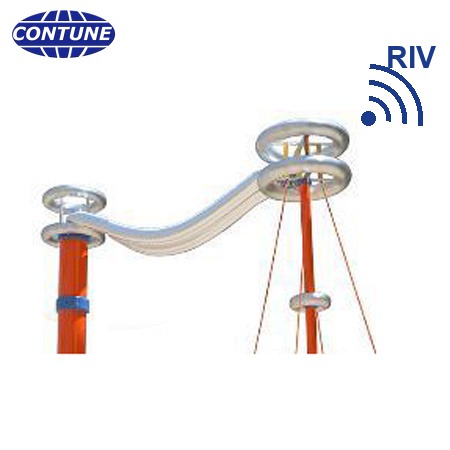
For an insulator RIV test-system RFQ, state the specimen and line configuration, the evaluation voltage and frequency, the receiver and coupling arrangement, the acceptable background noise, and the records your laboratory must deliver. A voltage rating alone cannot establish whether a radio-interference measurement will be usable: the installed test circuit and its own corona can dominate the reading.
IEC 60437:2023 describes a laboratory RI test on clean, dry insulators at 0.5 MHz or 1 MHz, with other frequencies from 0.5 to 2 MHz available. Its scope covers AC or DC overhead power and traction-line insulators above 1,000 V. Contune’s RIV test system page describes a CISPR 16-1-1 quasi-peak receiver, a 300 Ω coupling arrangement, programmable voltage control and 150–1,000 kV model options. Confirm the exact supplied configuration in the quotation; those are not universal requirements for every project.
Describe the specimen before choosing a voltage rating
Send drawings and dimensions of the porcelain, glass or composite unit or string. Identify conductor diameter, fittings, grading rings and suspension orientation. The intended arrangement matters because a corona source at a clamp or ring can change the result even when the insulator itself is unchanged. Specify whether the installation must accommodate AC, DC or both, and list the largest assembly including clearances.
Define the measurement chain and the laboratory background
| RFQ item | Buyer information to provide or request |
|---|---|
| Voltage source | Maximum test voltage, supply frequency or DC, available input power and regulation method |
| Receiver | Measurement frequency, detector type, calibration evidence and uncertainty statement |
| Coupling | Proposed impedance, circuit diagram, cable routing and grounding arrangement |
| Test object | Maximum string length, fittings, simulated conductor and grading rings |
| Background | Measured empty-circuit noise at the intended voltage and frequency; mitigation plan if excessive |
| Safety | Interlocks, emergency stop, flashover response and safe discharge procedure |
| Report | Voltage, frequency, RIV reading and units, specimen ID, environment, background check and curve/export format |
The published Contune product describes a 300 Ω coupling impedance and quasi-peak receiver. Ask the supplier to show the full connection diagram and calibration scope, not just the receiver brochure. Agree how background noise will be measured with the specimen absent or replaced according to the governing method. Do not infer a pass/fail limit from the machine’s voltage rating; the purchaser’s specification must define the evaluation point and acceptance limit.
What to demonstrate at factory acceptance
- Review the circuit drawing, shielding boundaries, grounding and clearances against the actual sample envelope.
- Confirm receiver calibration, selected frequency and detector setting, then record the laboratory background under the agreed condition.
- Run the programmed voltage sequence with a representative assembly and retain time-stamped voltage and RIV readings.
- Check that exported data identify the specimen, circuit configuration, receiver settings and any abnormal event.
- Demonstrate interlocks, emergency stop and safe discharge without putting an operator near energized parts.
Contune lists 150–1,000 kV system options, but the chosen rating, capacity and shielding should follow the installed test circuit, not a nominal transmission-voltage label alone. A site survey should also check floor area, ceiling height, earthing and ambient electromagnetic interference. Request a layout drawing and background-noise acceptance procedure before signing off the FAT.
FAQ
Does IEC 60437:2023 apply to wet or polluted insulators?
The IEC scope describes a laboratory test on clean, dry insulators. Do not treat a wet or pollution test as interchangeable with this procedure.
Is 0.5 MHz the only valid measurement frequency?
No. The IEC scope names 0.5 MHz and 1 MHz and allows other frequencies between 0.5 and 2 MHz. State the contractual frequency in the RFQ and report.
Can a 500 kV-rated source guarantee a valid RIV result?
No. Source rating is only one part of the design. Receiver setup, coupling, test-object geometry and background noise must also be verified.