


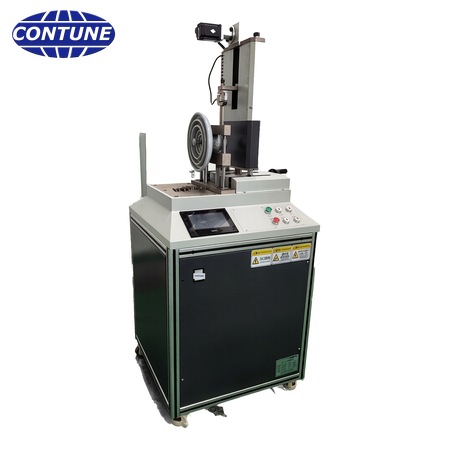
A locking pin prevents a ball-and-socket insulator coupling from separating in service. A useful test system must apply load in the pin axis without bending the pin or distorting the socket, capture peak force and protect the operator when the pin moves suddenly.
This guide uses Contune’s SJX-1A technical agreement dated 2026. Final loads and acceptance criteria must be taken from the applicable standard edition and purchaser procedure.
R-pin and W-pin loading are different
For an R-pin, the fixture applies tensile load through the pin eye along its axis. For a W-pin, the agreement specifies a rectangular steel bar engaging both curved ends and loading axially. A generic hook can create eccentric load and results that are not comparable.
Reference machine capability
| Item | 2026 agreement |
|---|---|
| Force range | 1–5000 N |
| Resolution | 1 N |
| Indication accuracy | Better than ±1% |
| Maximum stroke | 300 mm |
| Peak capture | Included |
| Environment | -20 to 50 °C, indoor ventilation |
| Supply | 220 V AC, approximately 1 kW |
Define the specimen envelope
Send drawings of ball, socket, pin and insulator. State whether porcelain or glass discs are tested singly or as two units, and provide the composite-insulator fitting dimensions. The source document lists locking systems associated with 70, 160, 210, 300, 420 and 550 kN insulator classes; these class ratings are not the pin pull load.
Test sequence and records
- Identify the specimen, pin type and fixture.
- Align the force axis and remove slack without pre-damaging the pin.
- Increase load at the procedure-defined rate.
- Record movement, release and peak force.
- Inspect pin, socket and fixture and retain the raw result.
FAT checklist
- Verify load indication with a traceable reference
- Demonstrate R-pin and W-pin fixtures
- Check alignment across the full adjustment range
- Confirm peak capture and result reset
- Test guard, emergency stop and safe access
- Run representative porcelain, glass or composite samples
FAQ
Is the insulator mechanical rating the required pin test force?
No. Use the load and acceptance criteria stated in the applicable locking-pin or insulator standard.
Can one fixture test both pin shapes?
Only if it provides the specified axial engagement for each shape. Dedicated adapters are normally clearer and more repeatable.