


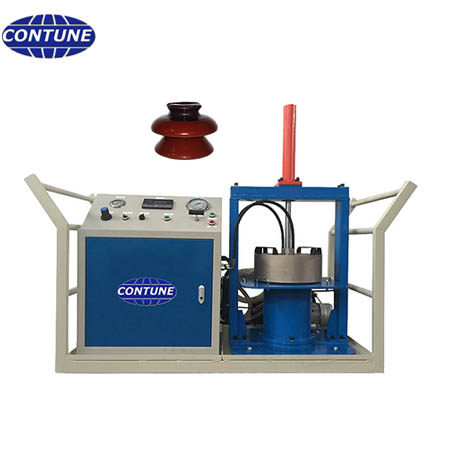
Porosity testing checks whether the fired porcelain body allows a dye solution to penetrate under sustained pressure. It is a destructive material test, so specimen preparation, pressure stability and interpretation of the freshly broken surface matter as much as the pressure rating of the vessel.
This guide is based on Contune technical material for the CTPT-35 and its reference to GB/T 775.1-2006, described there as equivalent to IEC 60383-1. Always confirm the current standard edition and purchaser specification before fixing acceptance criteria.
Prepare a representative specimen
Take the specimen from the thickest part of the porcelain unit. The source procedure covers porcelain disc, pin and post insulators. Break rather than saw the sample when the governing method requires it, identify the unit and location, and photograph the initial surfaces. A slight crack created during this first break must not later be confused with dye penetration through the porcelain body.
Control the dye solution and exposure
The source material specifies a fuchsin solution and a reference exposure of at least 20 MPa for 72 hours. Because solvent wording varies between procedures and translations, record the exact reagent grade, concentration, batch, preparation date and applicable method instead of relying on an informal formula. Confirm that seals, tubing and vessel materials are compatible with the chosen water/alcohol medium.
Reference CTPT-35 capability
| Item | Brochure value |
|---|---|
| Pressure range | 0-35 MPa |
| Peak pressure | 40 MPa |
| Recommended operating range | 0-25 MPa |
| Pressure control | Manual |
| Holding time | Adjustable for long-duration tests |
| Compatible medium | Water or alcohol-based solution |
The 40 MPa figure is a peak capability, not a routine test setpoint. Procurement should define the required working pressure, vessel certification, relief setting, gauge accuracy and inspection interval.
Run the 72-hour cycle safely
- Load labelled specimens without blocking solution circulation.
- Fill and vent the vessel so trapped air does not distort pressure behaviour.
- Raise pressure gradually and record the start time, stabilized pressure and solution temperature.
- Monitor pressure decay, leakage and any replenishment during the full hold.
- Depressurize completely and verify zero energy before opening.
The FAT should demonstrate the relief device, pressure indication, closure interlock or equivalent access control, leak tightness, controlled depressurization and a representative long-hold record.
Inspect the fresh fracture surface
After exposure, wash and dry the specimens, break them again and inspect the newly exposed section under consistent lighting. Record whether dye has entered the porcelain body, the maximum observed depth and its location. Distinguish true penetration from dye in a crack created during the original specimen preparation.
Minimum report fields
- Insulator type, manufacturer, batch and sample location
- Applicable standard edition and acceptance rule
- Dye formulation, batch and preparation time
- Pressure setpoint, actual trend, duration and temperature
- Equipment ID, gauge range and calibration status
- Pre-test and post-test photographs
- Observed penetration depth, location and disposition
RFQ and FAT checklist
- Largest specimen dimensions and number per batch
- Required working pressure and hold duration
- Solution chemistry and material compatibility
- Local pressure-vessel compliance and documentation
- Data logging, alarm and report requirements
- Installation utilities, ventilation and operator training
FAQ
Is 40 MPa the normal test pressure?
No. The brochure lists 40 MPa as peak capability and recommends operation up to 25 MPa. Use the pressure specified by the applicable test method.
Does dye in every crack mean failure?
No. A crack introduced while preparing the first specimen can retain dye. Evaluation focuses on penetration revealed in the fresh fracture surface according to the specified method.