


Water diffusion test device for FRP core
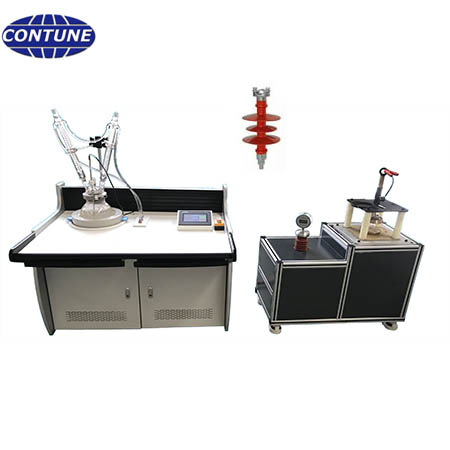

The water diffusion test device is to test the leakage current and withstand property of the FRP/ECR core of composite insulators under AC voltage after boiling in salty water. This test is defined and required in the IEC standard for tests of composite insulators.
Water diffusion test device at a glance
- Purpose: shows whether moisture can penetrate the fibre reinforced core of a composite insulator and destroy its insulation.
- Procedure: the core sample is boiled in water with 0.1% NaCl for 100 hours, cooled, and then energised while the leakage current is measured.
- Acceptance: no surface flashover and no breakdown during the voltage application, and the leakage current stays below the limit given by the standard, commonly 100 mA.
- Ratings: test voltage steplessly adjustable from 0 to 50 000 V, AC or DC; transformer capacity 5 kVA.
- Test object: FRP or ECR core samples of composite (polymer) insulators.
- Users: composite insulator manufacturers, core suppliers and testing laboratories.
1. What this device is used for
A composite insulator carries its mechanical load on a fibre reinforced plastic core, the FRP or ECR rod, which sits in the centre of the insulator and is covered by the housing. If moisture reaches that core along the interface or through a defect, the core can lose its insulating property and the insulator fails electrically even though it still looks sound. The water diffusion test is the sample test that checks this.
The test has two stages. In the first stage a sample of the core is boiled in water containing 0.1% NaCl for 100 hours, which drives moisture into the material. In the second stage the sample is taken out, allowed to cool in water, and then energised between two electrodes while the leakage current is measured. The device covers both stages: a boiling vessel, the electrode set for cores of different diameters, and the high voltage part with its control and measurement.
The result is a pass or fail per the applicable standard: no surface flashover, no breakdown, and a leakage current below the specified limit.
2. Standards applied
- IEC 61109 – Composite suspension and tension insulators for overhead lines with a nominal voltage above 1000 V. The water diffusion test is one of its sample tests on the core material.
- GB/T 19519 – the Chinese national equivalent for composite insulators for a.c. overhead lines. It states that no surface flashover and no breakdown shall occur during the test and that the leakage current shall not exceed 100 mA.
- IEC 62217 – Polymeric insulators for indoor and outdoor use; used together with IEC 61109 for the material and core test programme.
3. Technical parameters
| Item | Value |
|---|---|
| Test object | Sample of the FRP / ECR core of a composite insulator |
| Test medium | Water (boiling stage with 0.1% NaCl) |
| Test voltage range | 0 – 50 000 V, stepless adjustment |
| Output waveform | AC, DC selectable |
| Transformer capacity | 5 kVA |
| Test electrodes | 150 mm and 50 mm, one set each |
| Leakage current measurement | High voltage digital micro-current ammeter |
| Water boiling device | 1 set |
| Time control | Yes |
| Power supply | AC 220 V |
| Country of origin | China |
| Supplier | CONTUNE INTERNATIONAL CO.,LTD |
The high voltage part consists of the controller, the test transformer, the test bench, the leakage current measurement and the boiling device. The transformer has its own rectifier stack, which is shorted for the a.c. test so that the transformer output is a.c., and used for the d.c. test when d.c. is required.
4. Key functions
- Boiling stage: 100 hours of boiling in water with 0.1% NaCl, with time control.
- Voltage stage: steplessly adjustable test voltage up to 50 kV, a.c. or d.c.
- Leakage current measured and displayed during the voltage application.
- Two electrode sets (150 mm and 50 mm) so cores of different diameters are tested with the correct electrode spacing.
- Automatic protection and cut-off on overcurrent.
- Test report with voltage, leakage current and time.
5. Typical applications
- Composite insulator manufacturers – sample test on the core as part of the test programme of IEC 61109.
- FRP / ECR rod suppliers – qualification and batch verification of the rod.
- Material and high voltage laboratories – third party verification and comparison of core materials, including the acid proof ECR grades.
- Research – studies of moisture ingress and of the interface between core and housing.
6. Frequently asked questions
1. Why is the water diffusion test done on the core and not on the complete insulator?
The core is the load bearing part and the last electrical barrier inside the insulator. If moisture reaches it, the insulation of the whole insulator is compromised. Boiling a sample of the core drives moisture in quickly, so the material can be judged in a short laboratory test.
2. What is the acceptance criterion?
No surface flashover and no breakdown during the voltage application, and the leakage current must stay below the limit specified by the standard; GB/T 19519 states 100 mA.
3. Is the test voltage a.c. or d.c.?
Both are possible. The device supplies a steplessly adjustable voltage up to 50 kV and the output is selected as a.c. or d.c., depending on what the applicable standard or the purchaser requires.
4. How long does the whole test take?
The boiling stage alone is 100 hours with a tolerance of 0.5 hours, so the test is planned as a multi-day procedure: boiling, cooling in water, then the voltage application and measurement.
5. Which electrode set should I use?
The 150 mm and the 50 mm electrode sets are supplied so that the electrode spacing matches the sample diameter, which keeps the electrical stress on the sample the same for different core sizes.
6. Can the device also be used for the oil puncture test on the core?
No, that is a different test with a different medium and a different failure mode. The core puncture test is carried out in transformer oil and is served by a dedicated machine.
Related composite insulator test equipment
This device belongs to the electrical test equipment for insulators range. The electrical strength of the core material itself is measured with the FRP core oil puncture test machine, and the housing material is qualified on the tracking and erosion test machine. The full insulator testing machines catalogue covers the complete test programme for composite insulators.
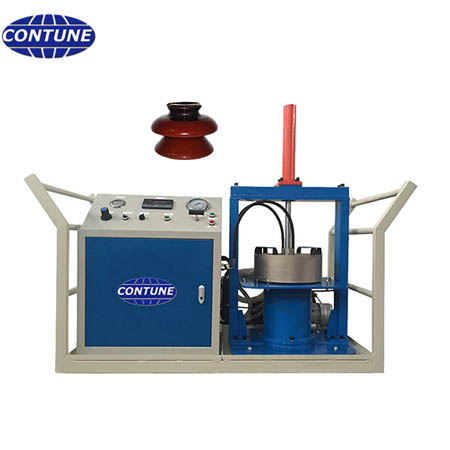
Insulator Porosity and Dye Penetration Tester for Porcelain Insulator Units
The insulator porosity test machine is to inspect the porosity property of the HV porcelain insulator under a constant high-pressure environment with dye penetration.