


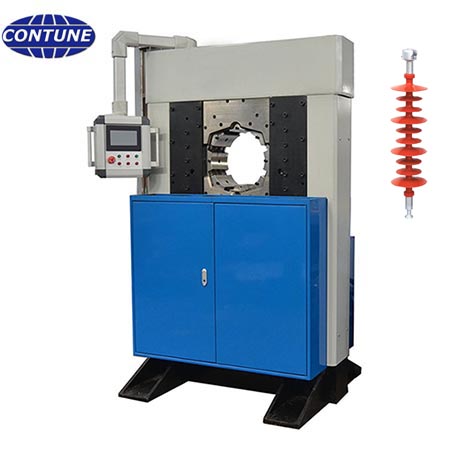
Selecting a crimping machine from press force alone can produce an unusable production cell. End-fitting diameter, die stack, insulator length, handling space, production rate, traceability and quality controls all affect the choice. This guide uses Contune’s 2026 CTCPM comparison sheet; final specifications must be confirmed in the quotation.
2026 catalogue comparison
| Item | CTCPM-140AS | CTCPM-165 |
|---|---|---|
| Typical voltage range | 11–33 kV | 66–400 kV |
| Crimping range | 8–200 mm | 10–200 mm |
| Maximum opening without dies | 215 mm | 340 mm |
| Pressing force | 3,200 kN | 6,000 kN |
| Minimum module length | 97 mm | 116 mm |
| Installed power | 5.6 kW | 7.5 kW |
| Acoustic emission | Integrated | Optional |
Start with the fitting and die envelope
Send drawings of every metal fitting, the FRP rod diameter, finished crimp diameter, insertion depth and available straight length. The 165 offers the larger opening and force, but a larger machine is not automatically better for short products. Confirm die segments, closed diameter and clearance with a sample drawing.
Choose force from the validated process
Required force depends on fitting material, wall thickness, crimp profile, die geometry and process qualification. Do not select 3,200 or 6,000 kN by voltage class alone. Define target dimensions, force limits, acceptance samples and destructive verification during FAT.
Controls and acoustic-emission monitoring
The 140AS catalogue lists PLC/touch HMI, automatic lubrication, a back stopper and integrated acoustic-emission monitoring. The system records pressure, acoustic level and displacement and can flag abnormal patterns. It supports process monitoring and traceability; it does not replace a validated crimp recipe, dimensional inspection or required destructive tests.
RFQ and FAT checklist
- Fitting and rod drawings, material and tolerances
- Product voltage classes and annual volume
- Crimp profile, die list and changeover target
- Required force, stroke, opening and handling height
- Data fields, product ID, CSV/JPG export and alarm rules
- Power supply, guarding, interlocks and operator access
- FAT samples, dimensional limits and destructive checks
- Installation, training, spares and calibration scope
FAQ
Is CTCPM-165 always the better choice?
No. It suits larger fittings and higher force, while the 140AS can be more appropriate for compact products and higher-throughput work.
Can acoustic emission guarantee that every FRP crack is found?
No. It is a process-monitoring aid whose thresholds must be validated against known good and defective samples.