


An IEC 60587 tracking and erosion test report should make the run reproducible. A result without specimen preparation, contaminant flow, voltage history, current events and termination reason is difficult for a buyer, laboratory auditor or material engineer to interpret.
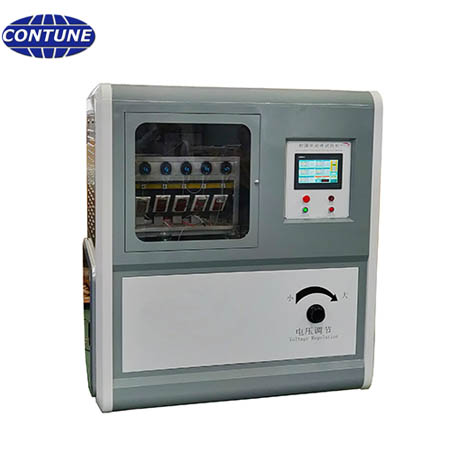
Contune brochure material for its integrated tracking and erosion test machine lists IEC 60587-2007 and GB/T 6553-2003, power-frequency operation from 48Hz to 62Hz, a 5kVA transformer, a voltage conditioner with 0–250V adjustable output, a working space of 800 × 570 × 800mm and overall dimensions of 1620 × 1000 × 1850mm. It also describes a multilingual touch screen showing time, voltage and flow status, plus a door interlock that cuts the high-voltage supply if the test tank is opened.
Confirm the standard edition and laboratory procedure
Before preparing specimens, record the standard edition, selected method, test voltage, contaminant formulation, flow rate, electrode arrangement, duration and failure criteria. The brochure gives a 2.5kV example with polluted-liquid flow and no overcurrent above 60mA during six hours; treat this as a configuration example and confirm the exact requirement from the edition and method used by your laboratory.
Prepare and identify every specimen
Assign a unique specimen ID and record material grade, batch, thickness, dimensions, conditioning, cleaning and mounting orientation. Photograph the initial surface under consistent lighting. Mark electrode positions without damaging the intended test path, and document any rejected or remade specimen.
Inspect electrodes and liquid delivery
Check electrode material, dimensions, spacing, contact and cleanliness against the procedure. Confirm that every liquid channel is free of blockage, that the pump or flow device is stable and that the contaminant reaches the intended path. Record solution batch, preparation time, conductivity or other required property, channel number and measured flow before energization.
Verify voltage, current and timing channels
Confirm the 48–62Hz supply requirement, voltage measurement path, current detection threshold and timer before a long run. The report should preserve target and measured voltage, start time, interruptions, current events and elapsed time. A touch-screen status display helps the operator, but raw data or event records are needed for later review.
Test the safety interlock before high voltage
Verify enclosure condition, grounding, emergency stop, exhaust or ventilation provisions and door interlock. The brochure states that opening the test tank interrupts high voltage. This function should be demonstrated during commissioning and checked periodically according to the laboratory safety system. Never defeat an interlock to continue a run.
Use an explicit termination record
When the run ends, select a reason such as completed duration, overcurrent, tracking criterion, erosion criterion, flashover, equipment alarm or operator stop. Record elapsed time and channel, photograph the surface, measure erosion where required and link all images and raw files to the specimen ID.
Minimum report fields
- Standard edition, method and acceptance rule
- Specimen material, batch, dimensions and conditioning
- Electrode identification, spacing and mounting
- Contaminant batch, property and flow by channel
- Frequency, target/measured voltage and current threshold
- Start time, duration, interruptions and alarms
- Termination reason and affected channel
- Before/after photographs and erosion measurements
- Equipment ID, calibration and operator approval
FAQ
Is the brochure’s 2.5kV, 60mA and six-hour example universal?
No. It is a useful equipment example, but the laboratory must follow the selected IEC 60587 method, voltage class, material requirement and standard edition.
Why record flow for each channel?
A blocked or unstable channel changes the wetting condition and may invalidate comparison between specimens.
Can the door interlock replace laboratory procedures?
No. It is one engineering control within a wider system of grounding, access control, training and documented operating steps.
Related resources: tracking and erosion machine, testing machines, project inquiry.