


Tracking & Erosion Test Machine of Polymer insulators
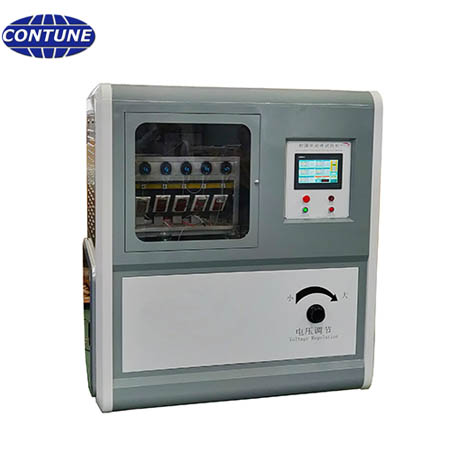
Tracking & Erosion tester is used for tests of silicon rubber shed and housing of electrical polymeric insulators. It is to test the anti-tracking and erosion ability of its silicon rubber material as per IEC or DIN EN standard.
- General Details
Tracking and erosion test machine at a glance
- Purpose: evaluates the resistance of the silicone rubber sheds and housing of a composite insulator to tracking and erosion under electrical stress and a flowing contaminated liquid.
- Test object: HTV silicone rubber samples taken from the shed and housing material of polymer insulators.
- Standard: the test methods and acceptance criteria of IEC 62217, which refers to IEC 60587 for the inclined plane procedure.
- Ratings: test voltage 100 V to 6000 V, AC or DC; transformer capacity 5 kVA; five samples tested at the same time.
- Pass criterion: at 2.5 kV, 3.5 kV or 4.5 kV with the specified contaminant flow, no overcurrent above 60 mA within six hours.
- Users: composite insulator manufacturers and the material laboratories that qualify their silicone rubber compounds.
1. What this machine is used for
The sheds and the housing of a composite insulator are made of silicone rubber. When an outdoor insulator is wet and polluted, leakage current flows over that surface and dries it in places; the resulting dry band arcs burn a conducting path (tracking) or wear the material away (erosion). This machine reproduces that condition in the laboratory in an accelerated form and shows whether the compound resists it.
The sample is mounted between two stainless steel electrodes 50 mm apart, and a contaminant liquid is fed onto it at a controlled rate while the voltage is applied. The operator sets the test duration, the voltage level and the flow rate, and watches the whole test through the glass viewing windows. The machine has five working positions, so five samples are tested in the same run and compared under identical conditions.
The result is used to qualify a shed and housing material, to compare compounds from different suppliers, and to verify production batches against the qualified material.
2. Standards applied
- IEC 62217 – Polymeric insulators for indoor and outdoor use with a nominal voltage above 1000 V: general definitions, test methods and acceptance criteria. Clause 9.3, tests of shed and housing material, is the clause this machine serves; it is part of the design and type test programme for composite insulators.
- IEC 60587 – Test method for evaluating resistance to tracking and erosion of electrical insulating materials used under severe ambient conditions. It defines the inclined plane procedure, the contaminant and the voltage levels of 2.5 kV, 3.5 kV and 4.5 kV.
- DIN EN equivalents – applied where the purchaser specifies the European harmonised version; the procedure and the acceptance criteria are the same.
3. Technical parameters
The values below are the standard configuration of the machine:
Item Value Model C-TETM Working positions 5 samples in one run Electrode thickness 0.5 mm Electrode material Stainless steel 304 Distance between upper and lower electrode 50.0 mm ±1% Test voltage 100 V – 6000 V, stepless adjustment in 3 levels Output waveform AC / DC switchable Voltage conditioner Output 0 – 250 V adjustable, capacity 5 kVA Transformer Capacity 5 kVA, maximum output AC 6000 V (DC 6000 V as an alternative) Voltage stabiliser Output AC 220 V, power 6000 W, accuracy 1% Voltage stability ±1% Overcurrent cut-off Output cut off at a circuit current of 60 mA Test duration 6 hours Contaminant flow range 0.005 – 20 ml/min by peristaltic pump Accuracy of liquid dropping Better than 0.5% Polluted liquid groove Stainless steel 316L with sealing device Dimensions (L x W x H) 1620 x 1000 x 1850 mm Total weight About 450 kg Pass criterion according to IEC 60587 as applied by IEC 62217: with the specimen energised at 2.5 kV, 3.5 kV or 4.5 kV and a defined flow of contaminated liquid, no overcurrent above 60 mA occurs within six hours.
4. Key functions
- Five independent test positions, so several samples or several compounds are compared in one run under identical conditions.
- Stepless voltage adjustment with AC or DC output, selected on the machine.
- Contaminant flow controlled by a high precision peristaltic pump, which keeps the flow constant for the whole six hours.
- Touch screen control showing time, voltage and flow status during the test.
- Glass viewing windows on the test tank so the tracking and erosion process is observed without interrupting the test.
- Automatic cut-off of the voltage output when the current exceeds 60 mA.
- Safety interlock: opening the tank door during the test stops the voltage supply immediately.
- Test report with the recorded voltage, current and time.
5. Typical applications
- Composite insulator manufacturers – qualification and periodic verification of the shed and housing compound, as required by the design and type tests of IEC 62217.
- Silicone rubber compound suppliers – development and comparison of HTV silicone rubber formulations.
- Material and high voltage laboratories – third party verification of material claims.
- Research institutes – ageing and pollution studies on polymeric housing materials.
6. Frequently asked questions
1. What is the difference between tracking and erosion?
Tracking is the formation of a permanent conducting path on the surface of the material, caused by repeated dry band arcing. Erosion is the loss of material, where the surface is worn away or pitted by the same discharge activity. A material can fail either way, and the test looks for both.
2. Which standard does this test belong to?
IEC 62217 clause 9.3, tests of shed and housing material, which is part of the design and type testing of composite insulators. That clause uses the inclined plane method of IEC 60587.
3. Why three voltage levels, 2.5 kV, 3.5 kV and 4.5 kV?
They are the severity levels defined by the test method. A material is qualified at a given level; running a higher level separates compounds that are close to each other in performance.
4. Can five different samples be tested together?
Yes, the machine has five working positions fed from the same supply, so all five see the same voltage and the same contaminant flow and the results are directly comparable.
5. What happens if the sample fails during the six hours?
When the leakage current exceeds 60 mA the output is cut off automatically and the channel is recorded as failed. The operator then examines the sample for tracking or erosion depth.
6. Is the test done with AC or DC?
Both. The output is switchable between AC and DC up to 6000 V, which lets the same machine serve the a.c. requirements and the d.c. requirements of a project.
Related polymer insulator test equipment
This machine belongs to the electrical test equipment for insulators range. The electrical tests on the core of a composite insulator are covered by the water diffusion test device for FRP cores and the FRP core oil puncture test machine. More material and electrical test equipment is listed in the insulator testing machines catalogue.
- Comments
One Comment
Leave a Reply
- Related Products
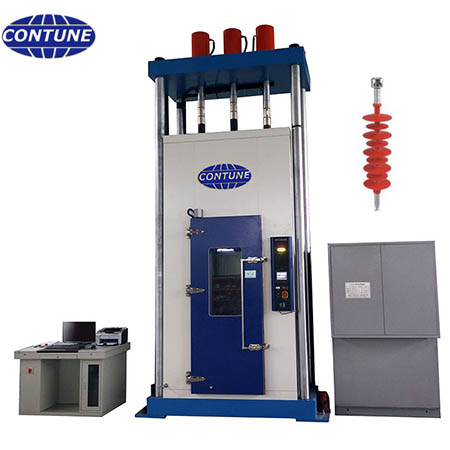
Insulator Testing Machine of Thermal-Mechanical Stress
The thermal-mechanical stress test is a sample test for composite insulators and porcelain insulators required in IEC. It tests insulators with the cycling of high temperatures and low-temperature environments.
Please send offer of test equipment of anti-tracking sample test of HTV silicon rubber,thanks