


Insulator Testing Machine of Thermal-Mechanical Stress
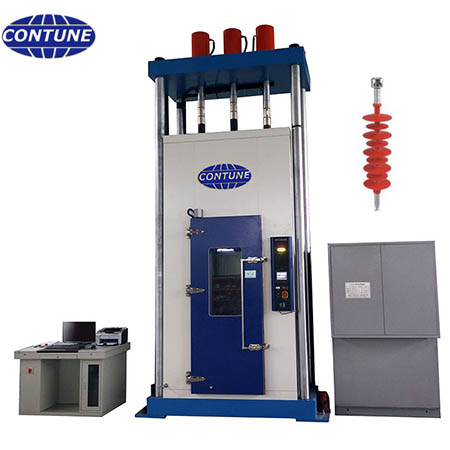
The thermal-mechanical stress test is a sample test for composite insulators and porcelain insulators required in IEC. It tests insulators with the cycling of high temperatures and low-temperature environments.
- General Details
Thermal-mechanical stress testing machine at a glance
- Purpose: the thermal-mechanical performance test — the insulator is held under tensile load while it is cycled between cold and hot, which is what a string on an overhead line sees between night and day and between winter and summer.
- Test cycle: four 24-hour cycles of cooling and heating, with a tensile load of 60% of the specified electromechanical or mechanical failing load held throughout.
- Specimens: ceramic disc insulators, glass disc insulators and composite (polymeric) tension insulators.
- Vertical models: C-TMT-1P500V to C-TMT-4P500V — 500 kN, accuracy class 0.5, one to four workstations, 300 mm cylinder stroke, 12 to 20 kW.
- Horizontal model: C-TMT-1P/600H — 600 kN, single workstation, chamber 3000 x 1000 x 800 mm.
- Standards: IEC/TR 60575 and GB/T 22708-2008 for the test method; IEC 61109 and GB/T 19519 for the composite insulator test programme.
1. What this machine is used for
An insulator string on an overhead line is never at a steady temperature. It carries its mechanical load all the time, while the temperature swings between night and day and between summer and winter. The thermal-mechanical performance test reproduces that combination in the laboratory: the insulator units are loaded into the cabinet at room temperature, a tensile load is applied, and the temperature is then cycled.
The test as specified in IEC/TR 60575 and GB/T 22708-2008 subjects the units to four 24-hour cycles of cooling and heating while they are held at a tensile load equal to 60% of the specified electromechanical or mechanical failing load. A unit that has a latent defect — a microcrack in the porcelain, a badly tempered glass disc, a weak crimped joint on a composite insulator — will show it during these cycles rather than in service.
The machine is therefore a sample test machine for insulator manufacturers, and it is also used by national laboratories and utilities to qualify a design before it is bought in quantity.
2. Standards applied
- IEC/TR 60575:1997 – Thermal-mechanical performance test and mechanical performance test on string insulator units — this is the standard that defines the four 24-hour cycles and the 60% load level.
- GB/T 22708-2008 – the Chinese national standard for the thermal-mechanical performance test and the mechanical performance test on string insulator units.
- IEC 61109:1992, MOD / GB/T 19519-2004 – Composite insulators for a.c. overhead lines with a nominal voltage greater than 1000 V — definitions, test methods and acceptance criteria, which call up the thermal-mechanical test for composite insulators.
- IEC 60383-1 – for the specified electromechanical or mechanical failing load that the 60% test load is calculated from.
3. Technical parameters
Vertical type — C-TMT … 500V
Item C-TMT-1P500V C-TMT-2P500V C-TMT-3P500V C-TMT-4P500V Workstation 1 2 3 4 Tensile load 500 kN 500 kN 500 kN 500 kN Accuracy level 0.5 0.5 0.5 0.5 Inner dimension of test chamber L x W x H (mm) 800 x 800 x 2000 1000 x 800 x 3400 1400 x 800 x 3000 1700 x 800 x 2800 Area occupation of the machine L x W x H (mm) 4000 x 1800 x 3800 4500 x 2000 x 5400 4800 x 2000 x 5000 5000 x 2500 x 4800 Number of disc insulators on each workstation 5 – 10 10 – 20 8 – 17 7 – 15 Cylinder stroke 300 mm 300 mm 300 mm 300 mm Power consumption 12 kW 15 kW 18 kW 20 kW Mechanical structure Vertical Vertical Vertical Vertical Horizontal type — C-TMT-1P/600H
Item Specification Model C-TMT-1P/600H Type and purpose Testing machine for polymeric tension insulators or ceramic disc insulators Number of workstations 1 Max tensile load 600 kN Accuracy 0.5 Cylinder stroke 300 mm Inner dimension of test chamber (mm) 3000 x 1000 x 800 Machine outer dimension (mm) 5500 x 2000 x 1600 Power input 3-phase AC 380 V Power consumption 18 kW Estimated number of disc insulators 8 – 17 pcs Connection for insulator Ball and socket fittings (can be changed to tongue and clevis type) Adaptable to foreign local voltage Yes, customisation optional The vertical type is chosen when the string is tested hanging as it hangs on the line; the horizontal type is chosen for long polymeric tension insulators and where the workshop height is limited. Both are computer controlled, so the operator sets the load, the cycle times and the temperature limits, and watches the live curve of load and temperature.
4. Key functions
- Holds the tensile load at 60% of the specified failing load for the whole test, with a load accuracy class of 0.5.
- Runs four 24-hour cooling and heating cycles automatically, with the temperature profile set from the control software.
- One to four workstations, so several strings are tested in the same run and the results are comparable.
- Computer control — the test procedure can be customised, watched, paused and saved, with a live curve of the tensile force and the temperature.
- Overcurrent and overpressure protection on the hydraulic system.
- Ball and socket fittings as standard, tongue and clevis on request; supply voltage adapted to the local network.
5. Typical applications
- Insulator manufacturers – sample test of the thermal-mechanical performance of ceramic, glass and composite string insulator units before a design is released.
- Composite insulator production – verification that the crimped end fitting holds under combined load and temperature cycling.
- National and utility laboratories – qualification of purchased lots and comparison of suppliers.
- Research and development – life evaluation of a new porcelain body, a new tempering process or a new crimping parameter.
6. Frequently asked questions
1. What exactly happens during the four cycles?
The insulator units are loaded into the cabinet at room temperature and the tensile load is applied. The cabinet then runs four cycles of 24 hours, each cycle going down to the cold limit and up to the hot limit, and the load is held at 60% of the specified electromechanical or mechanical failing load for the whole 96 hours. The units are then examined for failure.
2. Why 60% of the failing load?
Because that is the level IEC/TR 60575 and GB/T 22708 specify. It is high enough to open up a latent weakness when it is combined with the temperature cycling, and low enough that a sound unit passes the test without difficulty.
3. Should I take the vertical or the horizontal machine?
The vertical type loads the string as it hangs on the line and is the usual choice for disc insulator strings, with one to four workstations. The horizontal type is chosen for long polymeric tension insulators and where the available workshop height is limited; it is built as a single workstation machine at 600 kN.
4. How many insulator units fit into one run?
It depends on the model. On the vertical machines each workstation takes from 5 to 20 disc insulators depending on the chamber, and up to four workstations run at once. On the horizontal machine the single workstation takes about 8 to 17 disc insulators or one polymeric tension insulator string.
5. Can the machine be supplied for a voltage other than 380 V?
Yes. The power input is adapted to the local network of the country of installation; this is stated as a customisation option on the horizontal model and applies to the whole range.
6. Which insulators can be tested?
Ceramic disc insulators, toughened glass disc insulators and composite (polymeric) tension insulators, with ball and socket fittings as standard. Tongue and clevis fittings can be supplied instead.
Related mechanical test equipment
The load level of this test is related to the combined electro-mechanical strength tester and the horizontal tensile testing machine, and the routine 50 percent SML screening on the production line is done on the routine tensile testing machine (50% SML). The complete range is listed under insulator test equipment.
- Comments
- Related Products
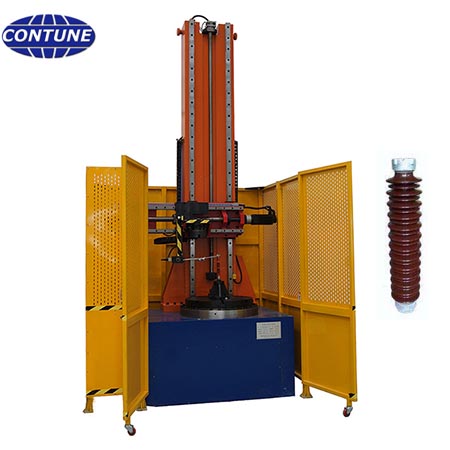
Insulators Testing Machine for Cantilever & Torsion Test
Cantilever & torsion test equipment is used for the mechanical bending test and the torsion test of post insulators according to the test methods and acceptance criteria of technical standard IEC 61109 and IEC 60383.