


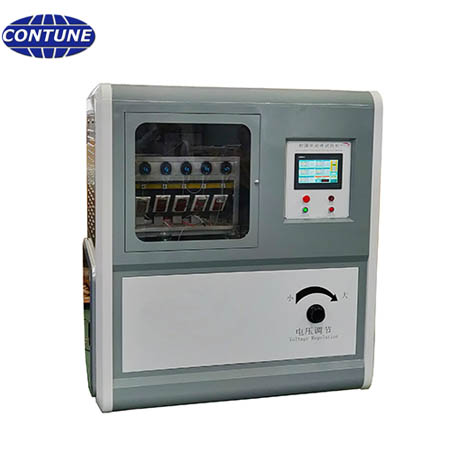
In horizontal tensile testing, maximum force is only one part of the specification. Loading speed, stroke, pressure-holding time and sample adjustment all influence whether the test follows the intended procedure.
These details are especially important for long rod composite insulators where fixtures, sample length and safety protection must work together.
Source facts used
- Loading speed is adjustable from 0-200mm/min.
- Pressure retaining time can be set freely during the test.
- Piston stroke is 600mm.
- Machine tracks force, loading speed and peak value protection.
- Force and displacement tracking are controlled automatically by computer.
- Movable self-locking tail stock supports long rod adjustment.
Why loading speed must be adjustable
Different standards and customer procedures may specify different loading rates or controlled force application.
An adjustable 0-200mm/min range gives the operator room to match the procedure instead of forcing every test into one speed.
Why stroke matters
A 600mm piston stroke gives space for elongation, fixture movement and controlled loading.
Insufficient stroke can stop a test before reaching the required force or holding condition.
Why tail-stock movement matters
Long rod samples vary in length. A movable self-locking tail stock reduces setup difficulty and improves repeatability.
Buyers should send maximum and minimum sample lengths before quotation.
Buyer checklist
- Loading speed range
- Piston stroke
- Pressure-holding time
- Sample length range
- Fixture adjustment
- Peak-value protection
FAQ
Can the same tensile tester cover different products?
Yes, if the load, stroke, bed length and fixtures cover the full product range.
Why is pressure-holding time useful?
Some tests require holding force for a defined time to observe stability or acceptance behavior.
Need a practical recommendation? Send product drawings, voltage class, test standard, sample size and destination country through the Contune contact page.