


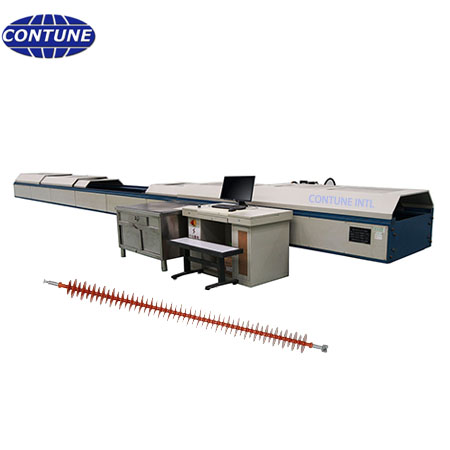
A useful RFQ for an insulator testing machine is more than a request for price. It gives the supplier enough verified information to select capacity, working envelope, fixtures, measurement channels, safety controls and reporting functions without guessing. A complete package also makes competing quotations easier to compare.
Begin with the product family and drawings
Identify whether the samples are composite long-rod, suspension, line-post, station-post, porcelain, glass or material coupons. Include dimensioned drawings, minimum and maximum length, shed diameter, mass, end fittings, mounting orientation and voltage class. Mark the exact points where load or voltage connections may be applied.
State the standard, edition and exact tests
Do not write only “IEC compliant.” List the standard number, edition, clauses or test names and any customer procedure. Separate tensile, cantilever, torsion, thermal-mechanical, power-frequency, wet flashover, puncture, tracking and erosion requirements. The same sample family may require very different equipment.
Translate the test into measurable machine requirements
For mechanical equipment, provide maximum load, preload, loading rate, hold time, stroke, displacement or angle and expected failure mode. As reference examples, Contune brochures list a 10m/1000kN horizontal tensile machine with 600mm piston stroke and 0–200mm/min loading speed, and a CTLWN500 with 300kN tensile, 20kN cantilever and 5kN·m torsion capability.
For high-voltage equipment, provide maximum test voltage, source kVA, frequency, test-object capacitance and dry or wet procedure. Contune examples include 150kV/50kVA for 33kV insulators and 250kV/100kVA for 11–66kV products, with IEC 60060-1 and IEC 60060-2 references. These are comparison references, not automatic selections for every product.
List fixtures, adapters and sample handling
Attach drawings for ball, socket, clevis, eye, base and terminal interfaces. State how many product variants must be covered and whether changeover time matters. For long or heavy samples, specify rollers, air supports, lifting points and loading height. Fixture capacity must cover the test load with an agreed safety margin.
Define software and report deliverables
Provide the required test sequence: preload, ramp, target, hold, unload and termination. List measured channels, sampling needs, live curves, alarms, user permissions, raw-data format, report language and fields. Ask how calibration IDs, fixture IDs, specimen numbers and interrupted runs appear in the final report.
Include site and commissioning information
Send room dimensions, doors, floor loading, power supply, compressed air, cooling water, drainage, grounding and environmental limits as applicable. For a high-voltage laboratory, include a scaled layout and safety boundary. State whether the quotation must include installation, commissioning, acceptance samples, training, documentation, spare parts and remote support.
Use a quotation comparison table
Compare suppliers against the same rows: model, rating, usable envelope, sensors, fixtures, safety, software, calibration, FAT, installation, warranty, exclusions and delivery. If one offer omits fixtures or commissioning, its lower price may not represent a lower complete-project cost.
RFQ package checklist
- Product list and dimensioned sample drawings
- Standards, editions, clauses and customer procedures
- Load, voltage, frequency, speed, stroke and duration
- Fixture and adapter drawings
- Measurement, software and report requirements
- Room layout, utilities, grounding and safety boundary
- FAT samples and acceptance criteria
- Installation, training, spares and documentation scope
- Delivery destination and required schedule
FAQ
Can the supplier select a model from voltage class alone?
Not reliably. Sample dimensions, capacitance, test method, margin, fixtures and site conditions can change the required configuration.
Should budget be included?
A target range can help prioritize options, but it should not replace the technical scope. Ask for clear base, optional and excluded items.
What is the most common missing RFQ item?
Detailed sample and fitting drawings. Without them, usable length, clearance and fixture scope remain uncertain.
Related resources: testing machines, laboratory planning, send an RFQ.