


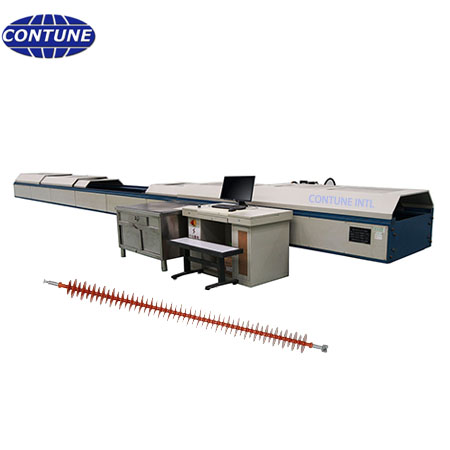
Thermal-mechanical testing is not only a load frame and a heating/cooling chamber. The fixture determines whether the load path represents the real insulator connection and whether the sample can survive repeated thermal cycles without artificial side stress.
Contune thermal-mechanical tester brochures describe vertical and horizontal arrangements, 500kN to 600kN load ranges and ball/socket connection planning for string insulators.
Source facts used
- Applicable references include GB/T19519-2004, IEC/TR 60575:1997 and GB/T22708-2008.
- The thermal-mechanical procedure includes four 24-hour heating and cooling cycles.
- Tensile load is planned as 60% of specified electromechanical or mechanical failing load per IEC 383.
- Vertical 2025 models include 1 to 4 workstation options up to 500kN.
- A horizontal single-station example lists 600kN maximum tensile load and 300mm cylinder stroke.
Fixture selection starts with the end fitting
Ball, socket, tongue, clevis and special customer fittings need different adapters. If the adapter forces the sample into a non-representative angle, the test result may reflect fixture error rather than insulator quality.
Before ordering, send end fitting drawings, mechanical failing load, sample length and the required standard. This lets the supplier design adapters before the machine layout is frozen.
Vertical and horizontal layouts affect handling
Vertical systems can be compact for some string insulators and may support multiple workstations. Horizontal systems are useful when the sample is long, heavy or easier to handle with rail support and a longer chamber.
The right choice depends on product length, load, workshop height, crane access, chamber size and expected sample throughput.
Record repeatability matters
Thermal-mechanical tests run for days, so load stability, temperature control and data recording are part of the fixture decision. A robust fixture should hold alignment during cycling and allow safe sample replacement.
For a broader comparison, see Contune resources on insulator testing machines.
Buyer checklist
- End fitting drawings and connection type
- Specified mechanical failing load
- Required load percentage and standard
- Sample length and weight
- Vertical or horizontal handling preference
- Temperature cycle and data record requirement
FAQ
Why are fixture drawings needed so early?
The fixture affects machine stroke, chamber opening, sample alignment and safety clearance. Late fixture changes can delay delivery.
Can one fixture set cover all products?
Sometimes, but most laboratories need adapter sets for different fittings and voltage classes.
Need help matching the specification? Send the sample drawing, voltage class, test standard, expected capacity and destination country through the Contune contact page.