


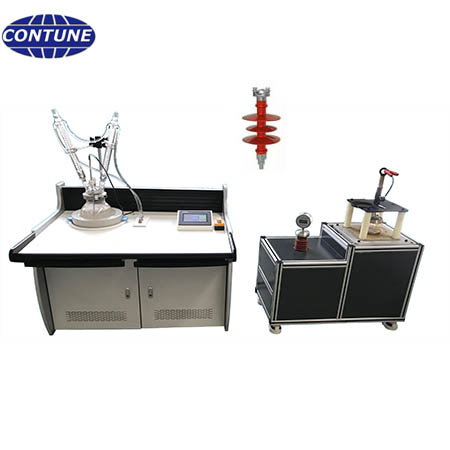
Water diffusion testing evaluates whether a glass-fibre-reinforced polymer (FRP) core for a composite insulator can resist moisture-related degradation. It is not simply a boiling bath or a dielectric tester. The workflow combines water conditioning, controlled voltage application and leakage-current observation.
This guide uses verified details from Contune’s water diffusion test equipment brochure. Specimen dimensions, conditioning time, voltage application and acceptance must still be confirmed against the applicable edition of IEC 62217 and the purchaser’s laboratory procedure.
What the test system must do
The brochure describes two functional sections: a boiling section and a measuring section. The high-voltage section includes a controller, transformer, test bench, electrodes and leakage-current measurement. The stated output is stepless adjustable from 0 to 50 kV, with AC and DC configurations available.
| Function | Buyer check |
|---|---|
| Water conditioning | Capacity, temperature control, timer, cooling and specimen throughput |
| Voltage source | Required AC/DC mode, usable range, regulation and indication accuracy |
| Electrodes | Material, geometry, contact consistency and compatible rod diameters |
| Current measurement | Range, resolution, trip setting, recording and calibration |
| Safety | Earthing, interlocks, emergency stop, discharge and barriers |
Specimen and electrode preparation
Cut and identify specimens according to the approved method. Record the parent rod or batch, diameter, length, preparation date and operator. Prepare cut faces consistently and keep them free of oil, dust and conductive residue.
The equipment brochure specifies brass electrodes on a fixed base and a movable threaded guide rod. Before energising, verify clean, aligned and repeatable contact. Unequal contact can cause local heating, unstable current or misleading flashover behaviour.
Boiling, transfer and voltage workflow
- Check vessel cleanliness, water level, temperature sensing and timer.
- Load labelled specimens without unintended contact with heaters or vessel walls.
- Use the water condition, temperature and duration required by the applicable method.
- Record conditioning end, removal and electrical-test start times; uncontrolled drying can change the conditioned state.
- Verify protective earth, emergency stop, access interlock and zero-voltage start.
- Apply voltage and current protection according to the approved procedure while recording voltage and leakage current.
The brochure references GB/T 19519 and states that flashover and breakdown should not occur and leakage current should not exceed 100 mA. A laboratory working to IEC 62217 must confirm the exact conditions and acceptance criteria in the applicable edition instead of treating a brochure summary as the standard.
Minimum report fields
- Standard, edition and laboratory procedure
- Rod manufacturer, material, batch, diameter and specimen dimensions
- Water type, conditioning temperature and all relevant times
- Electrode identification, setup and connection mode
- AC/DC configuration, voltage, ramp and duration
- Leakage-current values, peaks, trips and instrument range
- Flashover, breakdown, carbonisation or other observed damage
- Equipment serial numbers, calibration status, operator and witness
What to include in an RFQ
State the standard and edition, rod diameter range, throughput, AC or DC requirement, local power supply, recording method and safety requirements. Also specify FAT, calibration certificates, installation and training. Review the composite insulator test laboratory equipment list or send Contune your specimens and test requirements.
Frequently asked questions
Is a boiling bath enough?
No. The workflow also requires controlled voltage, suitable electrodes and leakage-current measurement.
Should the system use AC or DC?
That depends on the applicable standard and customer procedure. Define the required mode in the RFQ.
What harms repeatability?
Inconsistent specimen preparation, uncontrolled transfer time, variable electrode contact and incomplete voltage/current records.