


Laser Marking Machine for Composite Insulators
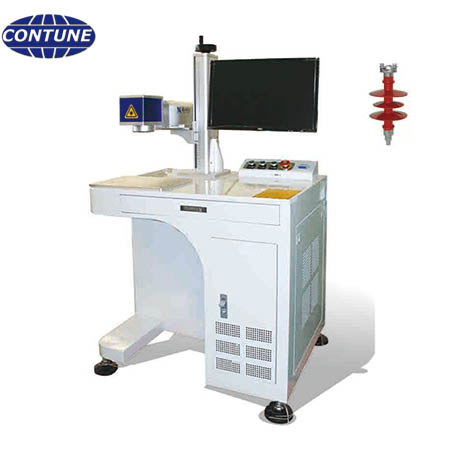
Laser marking machine is applied in marking words, logo, symbol, character, etc. on multi-material items. It has advantage of wide adaptability, fast speed and high precision.
Laser marking machine at a glance
- Purpose: marks the model designation, the manufacturer name or logo and other characters directly on the polymeric sheds of a composite insulator.
- Why laser and not printing: the mark goes into the material instead of sitting on top of it, so it stays readable after years of service on the line, where paint or ink does not.
- Laser: fibre laser, 1064 nm wavelength, output power 10 W, 20 W, 30 W or 50 W (CTLM-10 / 20 / 30 / 50).
- Marking: scope 110 x 110 mm (200 x 200 mm), line width 0.01 – 0.1 mm, depth 0.01 – 5 mm depending on the material, speed up to 7000 mm/s.
- Supply and cooling: 220 V / 50 Hz / 500 W, air cooled, no wearing parts and low power consumption.
- Other uses: the same machine marks metal, plastics and many other products, so it is not idle when the insulator line is not running.
1. What this machine is used for
A composite insulator has to carry its identification for the whole of its service life: the manufacturer name or trade mark, the type or model designation and the year of manufacture. On a polymeric insulator these marks are put on the sheds, and the way to make them permanent is to mark them with a laser.
The laser marker marks words, logos, symbols and characters on the silicone rubber housing. Because the mark is made by the laser itself and not by paint or ink, it does not come off — it is still readable after a long time in service on the power line, which is exactly what an inspector or a future buyer needs when he looks at an insulator on a tower.
The same machine is used on many other materials. Manufacturers run it on hardware, instruments, electronic components and consumer goods as well, so the investment is not tied to the insulator production line alone.
2. Marking requirements on an insulator
- IEC 61109 – Composite suspension and tension insulators for overhead lines with a nominal voltage greater than 1000 V – Definitions, test methods and acceptance criteria. The standard requires the insulator to be marked, and the mark has to stay legible in service.
- GB/T 19519-2004 – the Chinese national standard corresponding to IEC 61109:1992, MOD, with the same marking requirement.
- Purchaser specifications – utilities often add their own asset number, a bar code or a data matrix code, which the machine marks in the same operation.
3. Technical parameters
| Item | CTLM-10 | CTLM-20 | CTLM-30 | CTLM-50 |
|---|---|---|---|---|
| Max power of laser output | 10 W | 20 W | 30 W | 50 W |
| Wavelength of laser | 1064 nm | |||
| Marking scope | 110 x 110 mm (200 x 200 mm) | |||
| Marking linear width | 0.01 – 0.1 mm | |||
| Marking depth | 0.01 – 5 mm (optional, depends on material) | |||
| Marking speed | ≤ 7000 mm/s | |||
| Power supply required | 220 V / 50 Hz / 500 W | |||
| Cooling system | Air cooling | |||
The output power is chosen from the material and from the cycle time needed: the higher the power, the faster the mark is made and the deeper it goes into the material.
4. Key functions
- Marks the model designation, the manufacturer name and the logo on polymeric sheds, with a better effect, higher efficiency and better durability than paint brushing.
- Stable output power and a good optical mode give a fine, even marking line — down to 0.01 mm line width — for work that needs depth, smoothness and precision.
- Marking speed up to 7000 mm/s, so the mark keeps up with the production line.
- Marking depth adjustable from 0.01 mm to 5 mm, selected for the material.
- Air cooled, no wearing parts, low power consumption and simple operation.
- Suitable for mass production on a line, and for many other products and materials besides insulator sheds.
5. Typical applications
- Composite insulator production – marking the sheds of pin, post, suspension and tension polymeric insulators.
- Insulator identification – asset numbers, bar codes and data matrix codes for utilities that track each unit.
- Electronics and electrical industry – IC chips, computer accessories, instruments, precision components and electrical appliances.
- General industry – hardware tools, aerospace parts, jewellery, clocks, gifts, office supplies, sanitary ware, tableware, and food, beverage, tobacco and alcohol packaging.
6. Frequently asked questions
1. Why should a composite insulator be marked with a laser instead of paint?
Because the mark has to survive the service life of the insulator. A laser mark is made into the material, so it is still readable after years on the power line; paint brushing and other printed marks fade, peel or rub off, which leaves the unit unidentified in the field.
2. Which laser power do I need?
The range runs from 10 W to 50 W. The power is selected from the material and from the cycle time: a higher power marks faster and deeper. For marking the model name and logo on silicone rubber sheds, the 20 W model is the usual starting point.
3. Can the machine mark a curved shed surface?
Yes. The marking scope is 110 x 110 mm (200 x 200 mm optional) and the focus is set to the shed surface, so the mark follows the shape of the sheds.
4. How deep does the mark go?
The marking depth is adjustable from 0.01 mm to 5 mm and depends on the material. On silicone rubber sheds a shallow, high contrast mark is normally used.
5. Is the machine difficult to run on a production line?
No. It is air cooled, has no wearing parts, consumes 500 W from a 220 V supply and is designed to be operated by the line worker, including for mass quantity work on a conveyor.
6. Can the machine be used for products other than insulators?
Yes. It marks metal, plastics and many other materials, and is used for electronics, hardware tools, instruments, jewellery, gifts, sanitary ware and packaging as well as for insulator sheds.
Related composite insulator production machines
On a composite insulator production line the marker is used with the crimping machine CTCPM-165, the crimping machine CTCPM-140AS and the FRP rod sanding machine. The complete line is listed under insulator production machines.
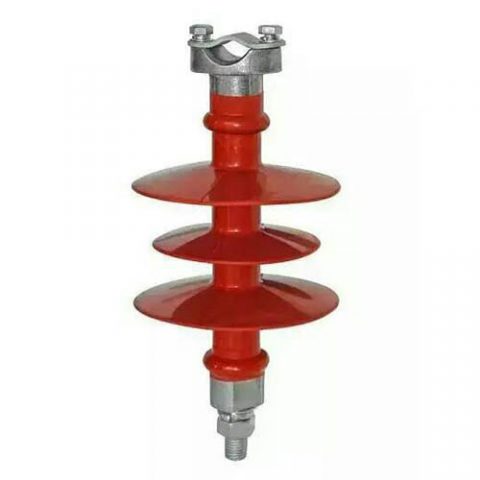
11 kV Composite Pin Insulator for Overhead Distribution Lines
11KV composite pin insulators are used on 11KV high voltage overhead power distribution lines. These pin insulators are made by FRP core, silicon rubber, and metallic fittings. On the bottom side of the fitting, it is where we call pin, the pin has a screw which is used to fix the insulator onto the cross-arm. On header fitting, it usually has a groove shape to fix conductors.