


Insulators Production Machine for Frp Grinding
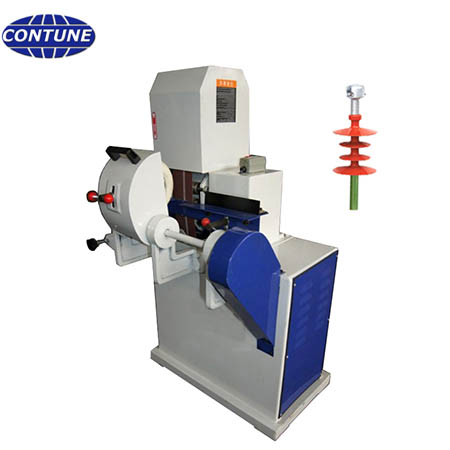
FRP grinding machine is applied in the production line of electrical silicon rubber composite insulators of overhead power lines. It provides an essential technic during the production process.
FRP rod sanding machine at a glance
- Purpose: grinds the surface of the FRP or ECR core so the silicone rubber housing bonds to it tightly and without gaps.
- Why it matters: the bond between the core and the housing is one of the critical interfaces of a composite insulator; sanding increases friction and contact area for the adhesive.
- Capacity: rod diameter 8 mm to 50 mm, feeding speed 5 to 15 m/min.
- Ratings: 3 kW motor, 380 V three phase; sanding belt 1820 x 115 mm.
- Size: 800 x 700 x 1300 mm, about 180 kg.
- Users: composite insulator manufacturers, on the core preparation station of the production line.
1. What this machine is used for
A composite insulator is built from a rod shaped fibreglass core, the FRP or ECR rod, and a polymer housing with sheds that covers it. The housing must adhere tightly to the rod, with no gaps and no cracks at the interface. Sanding is the step that makes this possible: it turns the smooth surface of the rod into a rough one, which increases friction and contact area so the adhesive bonds to the rod properly.
The machine is driven by an electric motor and grinds the rod at a constant speed and with uniform force, so every rod of a batch receives the same treatment and the tolerance stays within a narrow range. That repeatability is what allows the bonding quality to be managed on a production line rather than judged afterwards.
It is used for the cores of long rod insulators (suspension, tension and dead-end types), pin type insulators and post type insulators, over a wide range of rod diameters.
2. Technical parameters
| Item | Value |
|---|---|
| Facility name | FRP / ECR rod grinding machine |
| Model | CTRSM-90 |
| Application | Production of composite (polymer) insulators |
| Feeding speed | 5 – 15 m/min |
| Power consumption | 3 kW |
| Power supply | 380 V, three phase |
| Sanding belt size | 1820 x 115 mm |
| Rod diameter range | 8 mm – 50 mm |
| Outer dimensions (L x W x H) | 800 x 700 x 1300 mm |
| Approximate weight | 180 kg |
| Manufacturer | CONTUNE INTERNATIONAL CO.,LTD |
Other rod diameters and motor ratings are supplied to order for cores outside the range above.
3. Key functions
- Powered sanding of the FRP / ECR rod at constant speed and uniform force.
- Steplessly set feeding speed in the range 5 – 15 m/min, so the roughness is matched to the rod and to the housing compound.
- Handles the rod diameters used for long rod, pin and post insulators.
- Sanding belt of 1820 x 115 mm, replaced quickly during maintenance.
- Simple structure for easy installation, operation and maintenance on the production line.
4. Typical applications
- Core preparation ahead of the injection or extrusion of the silicone rubber housing.
- Long rod composite insulators – suspension, tension and dead-end types.
- Pin type and post type composite insulators.
- Production lines where the bonding between core and housing has to be repeatable and documented.
5. Frequently asked questions
1. Why does the core have to be sanded?
Sanding roughens the smooth surface of the fibreglass rod, which increases friction and contact area. The adhesive then bonds to the rod far better, and the housing adheres tightly without gaps or cracks at the interface.
2. Which rod diameters can be sanded?
8 mm to 50 mm as standard. Other diameters are handled by a machine configured to order.
3. Does sanding damage the rod?
No. The machine grinds at constant speed and with uniform force, removing only the surface layer. The tolerance is controlled within a narrow range so the mechanical strength of the core is not affected.
4. How fast is the machine?
The feeding speed is set between 5 and 15 metres per minute, depending on the rod diameter and on the surface finish the housing compound requires.
5. Which insulators use sanded cores?
Long rod insulators for suspension, tension and dead-end applications, pin type insulators and post type insulators.
6. Is the machine difficult to maintain?
No. The structure is simple, the sanding belt is replaced quickly, and routine maintenance is limited to the belt and the drive.
Related composite insulator production machines
This sanding machine belongs to the insulator production machines range and prepares the FRP / ECR core rod for composite insulators before the housing is applied. The end fittings are then pressed on with the crimping machine CTCPM-140AS and the unit is marked with the laser marking machine.
Contact us to know more about this machine
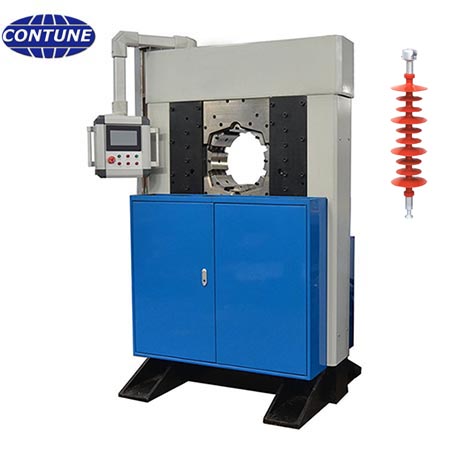
Crimping Machine 165 for Composite Insulator Production
The crimping machine is applied in the production line of high voltage composite insulator (polymer insulator) to crimping metallic end fittings to FRP of the insulator. Model 165 is available for an insulator with voltage up to 800KV